Skip to content
Posh Crisps
A white bowl of golden crisps flecked with dark skin, a wedge of cloth-bound cheddar and a bundle of whole spring onions on a wool rug over a stone wall, with the limestone walls of a Somerset gorge and a narrow road curving away behind under flat white sky.

Cheddar Gorge, Somerset

Mature Cheddar & Spring Onion


No. III of VIIISomersetMature Cheddar

Eleven degrees, all year, in the dark under the Mendips.

Number III of eight. The place is Cheddar Gorge, Somerset. The earliest date on this page is 1170, and every claim after it is listed in the sources at the foot of the page.


I

Water cut it, not ice.

The gorge was made by meltwater and frost. It began forming about 1.2 million years ago, when the climate here was warm and arid, not unlike northern Africa today, and flash floods scoured wadis into the limestone. In the cold phases permafrost plugged the caves below with ice and frozen mud, so the water had nowhere to go but the surface, where it stripped out the softer rock filling the old wadi and cut down.

No glacier ground through: the ice worked at a distance, by blocking the drainage and then melting. What is left is England's largest gorge, three miles long and 137 metres deep at its worst, cut through Carboniferous limestone laid down more than 300 million years ago.

The river is under your feet rather than beside them. The Cheddar Yeo rises near Charterhouse, sinks into the limestone, runs through the rock as the largest underground river system in Britain, and comes back out at Gough's Cave. As early as 1130 the gorge was being listed among the four wonders of England.
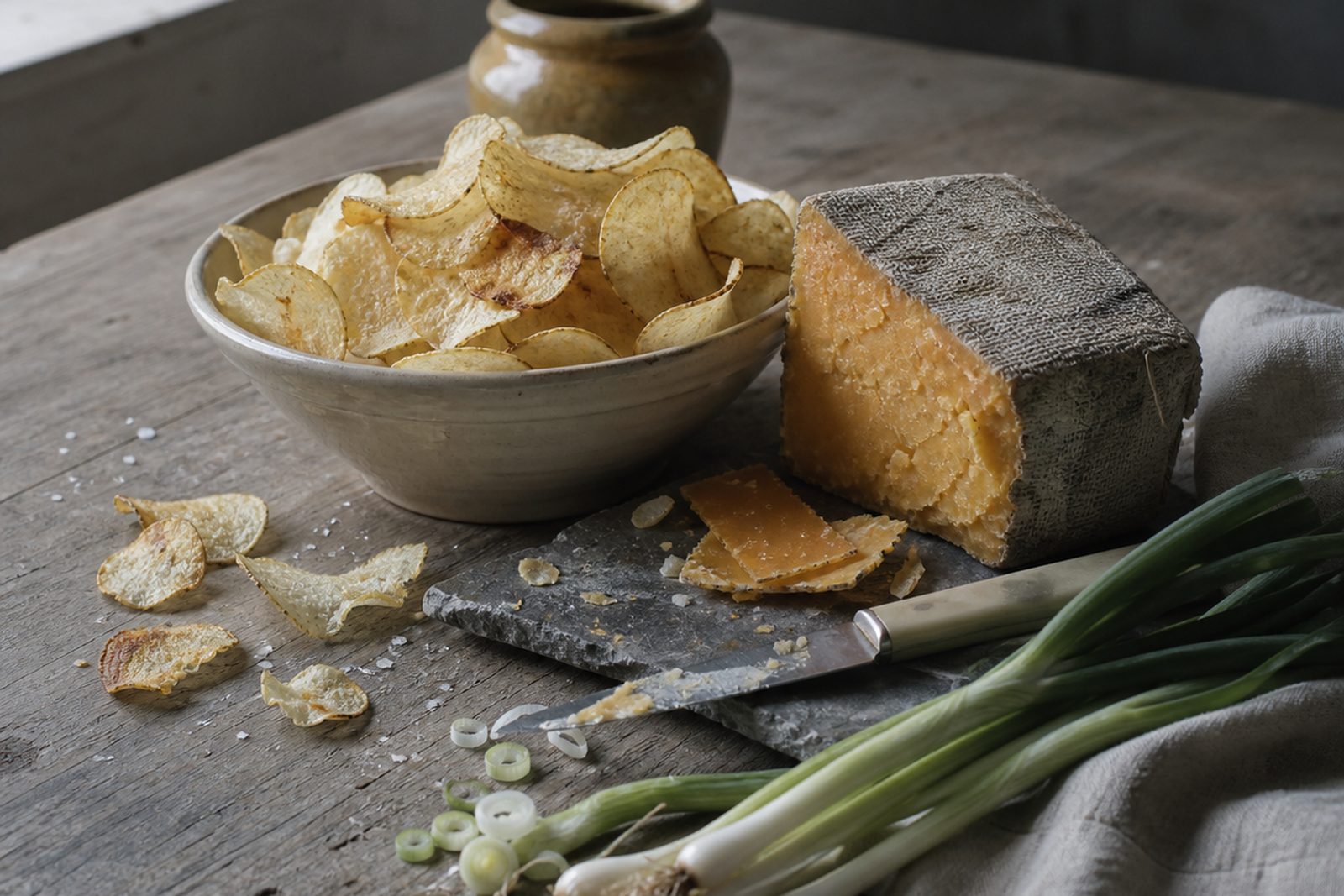
A cream stoneware bowl of pale cupped crisps on a weathered plank table, beside a cloth-bound cheddar truckle with a cut face, thin shavings of cheese and a bone-handled knife on a slate board, sliced spring onions, a stoneware jar behind and broken crisps and salt at the left.
Fig. I A cloth-bound truckle with a cut face, and spring onions. Generated image
II

A farthing a pound.

The village is in Domesday in 1086, as Cedre. The cheese enters the record eighty-four years later.

The Pipe Roll for 1170 has Henry II buying 10,240 lb of Cheddar at a farthing a pound: ten pounds, thirteen shillings and fourpence, for four and a half tons. The pipe rolls are the oldest continuous series of English government accounts, running from 1155 to 1833, so the cheese arrives in history the way most English things do, as a line in an audit. It stayed dear.

Thomas Fuller, in the Worthies of England, published in 1662, the year after his death, called them the best and biggest in England, and said their worst fault was that they are so few and dear, hardly to be met with, save at some great man's table. By the reign of Charles I the court is said to have bought the cheese before it was made.

Eleven degrees, all year, in the dark under the Mendips.
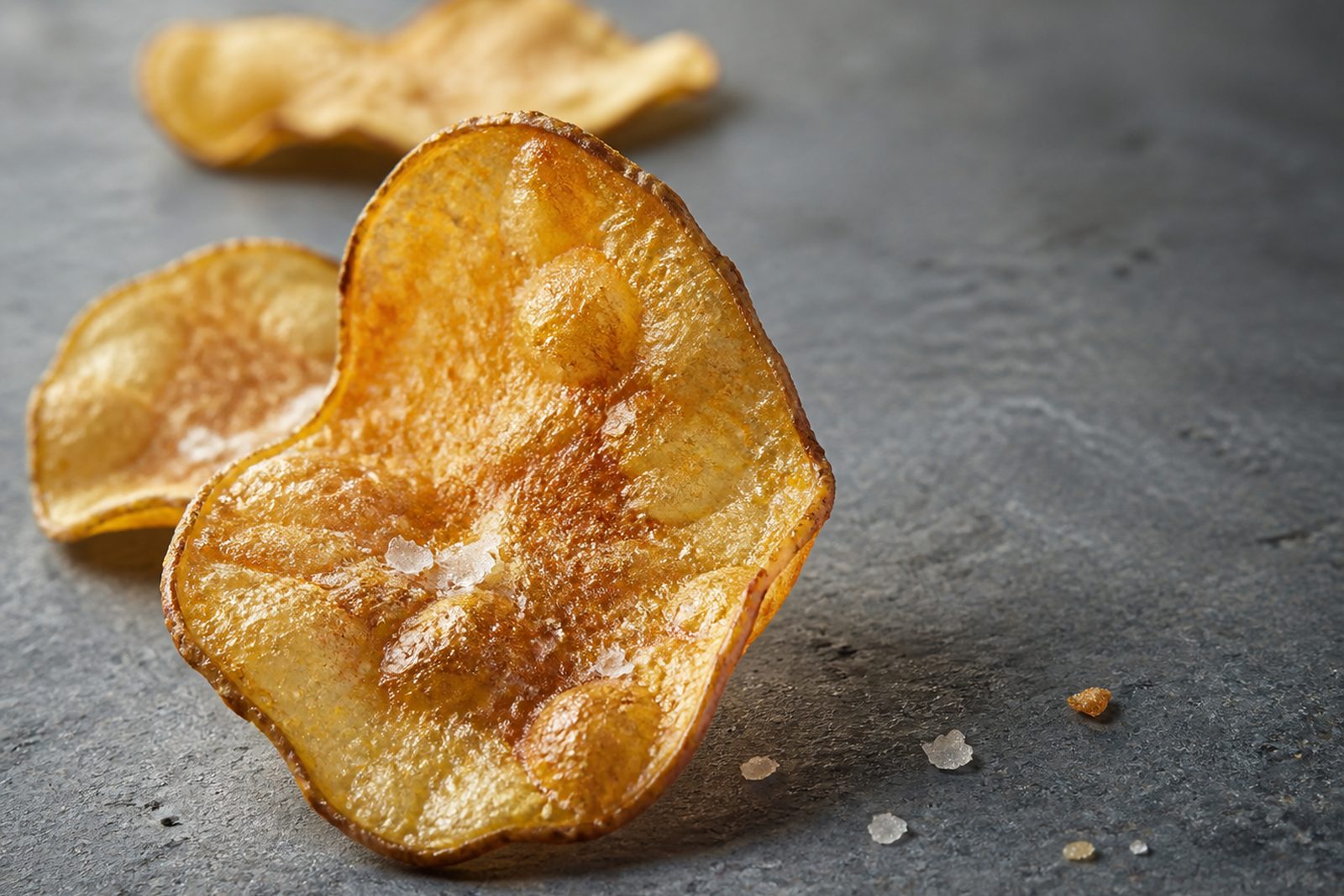
Extreme close-up of a single golden hand-cooked crisp standing on grey slate, its surface covered in irregular blistered domes and a rippled darker-flecked rim, with coarse salt crystals embedded in the oil and two softly out-of-focus crisps behind it.
Fig. II One crisp at close range. The blistering is what frying does to starch. Generated image
III

One cheese, from everybody's milk.

Fuller called them Corporation Cheeses, made by the joint dairies of the whole parish putting their milk together, each one, poor and rich, receiving a share according to their proportion. That is why the cheese is hard, big and long-keeping: bandaged in muslin dipped in melted lard, which forms a rind that lets it breathe and keeps mould out, a cylinder of it travels and waits in a way a small soft cheese cannot.

Joseph Harding, born at Wanstrow in 1805, turned the craft into a method — hygiene, temperature, a revolving breaker for the curd, a formula anyone could repeat — and published it in the Journal of the Royal Agricultural Society of England in 1860.

He had been taught farming and cheesemaking by his aunt Elizabeth, who ran a dairy of eighty cows at Marksbury, and much of his experimental work was done there. His summary: cheese is not made in the field, nor in the byre, nor even in the cow, it is made in the dairy.
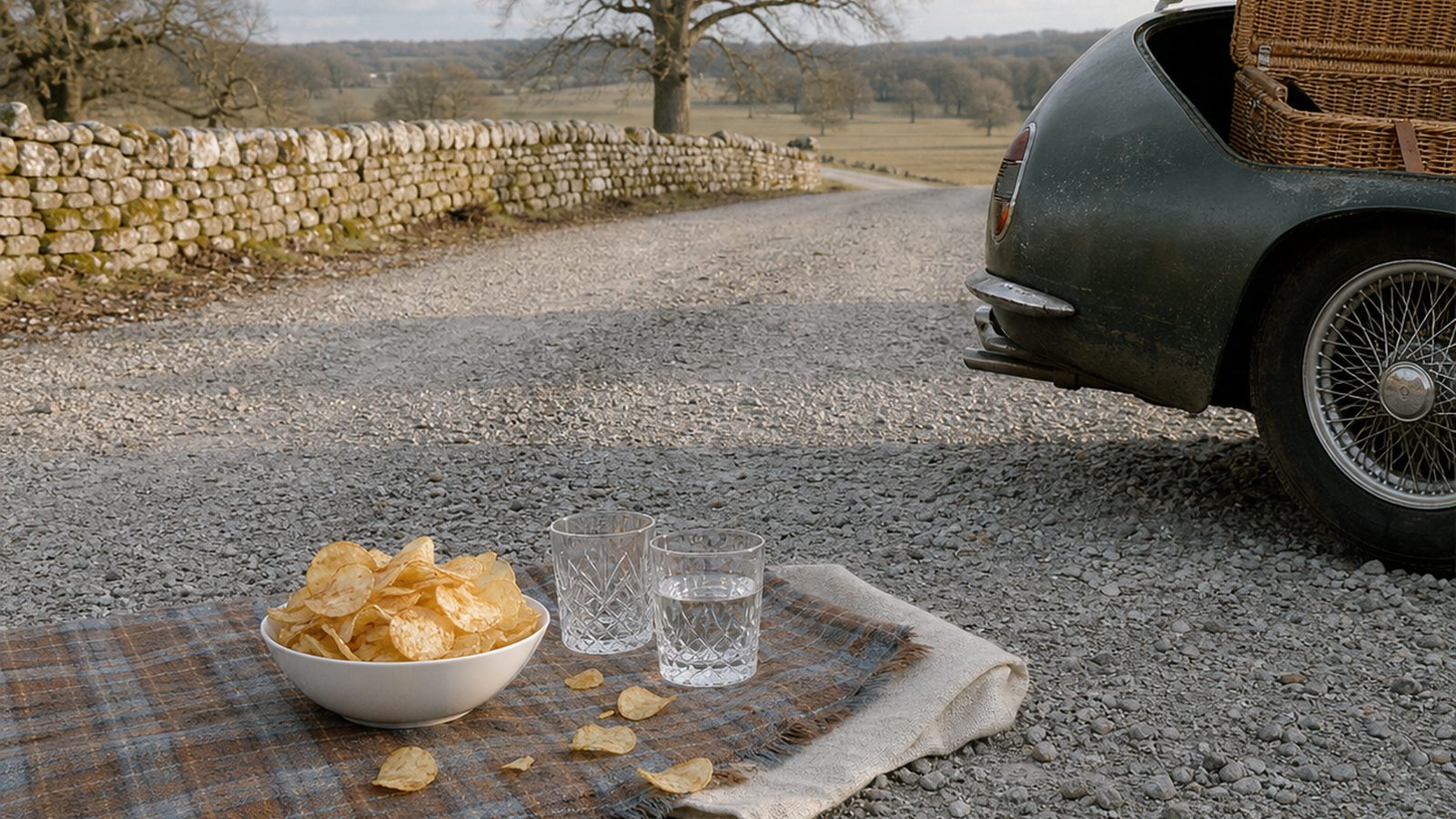
A white bowl of crisps and two cut-crystal tumblers of water on a tartan rug spread over a gravel drive, with fallen crisps on the wool, and the unbadged rear wing, wire wheel and wicker-loaded boot of a dark green vintage sports car at the right beside a dry stone wall.
Fig. III Gravel, wool and an open boot. The English picnic is a weather event. Generated image
IV

The cave, and the chibol.

Gough's Cave holds a constant eleven degrees and high humidity, and there is cheese maturing on shelves inside it. That started in December 2006, when a dairy in the village began ageing truckles in the gorge; Wookey Hole, about five miles south-east under the same hills, began ageing cheddar in a side tunnel the same year. The trade likes to date the practice to the middle ages.

The product specification lodged with government says only that tradition has it, which is the honest phrasing and the one worth keeping. The onion is better documented.

The Forme of Cury, compiled about 1390 by the master cooks of Richard II, gives one of the earliest salad recipes written in English: parsley, sage, garlic, chibolles, onions, leek and the rest, plucked small by hand and dressed with raw oil, vinegar and salt. Chibolles are young onions, the things we now call spring onions. Thomas Tusser was still listing them, as poret, in Five Hundred Points of Good Husbandry, first printed in 1573.
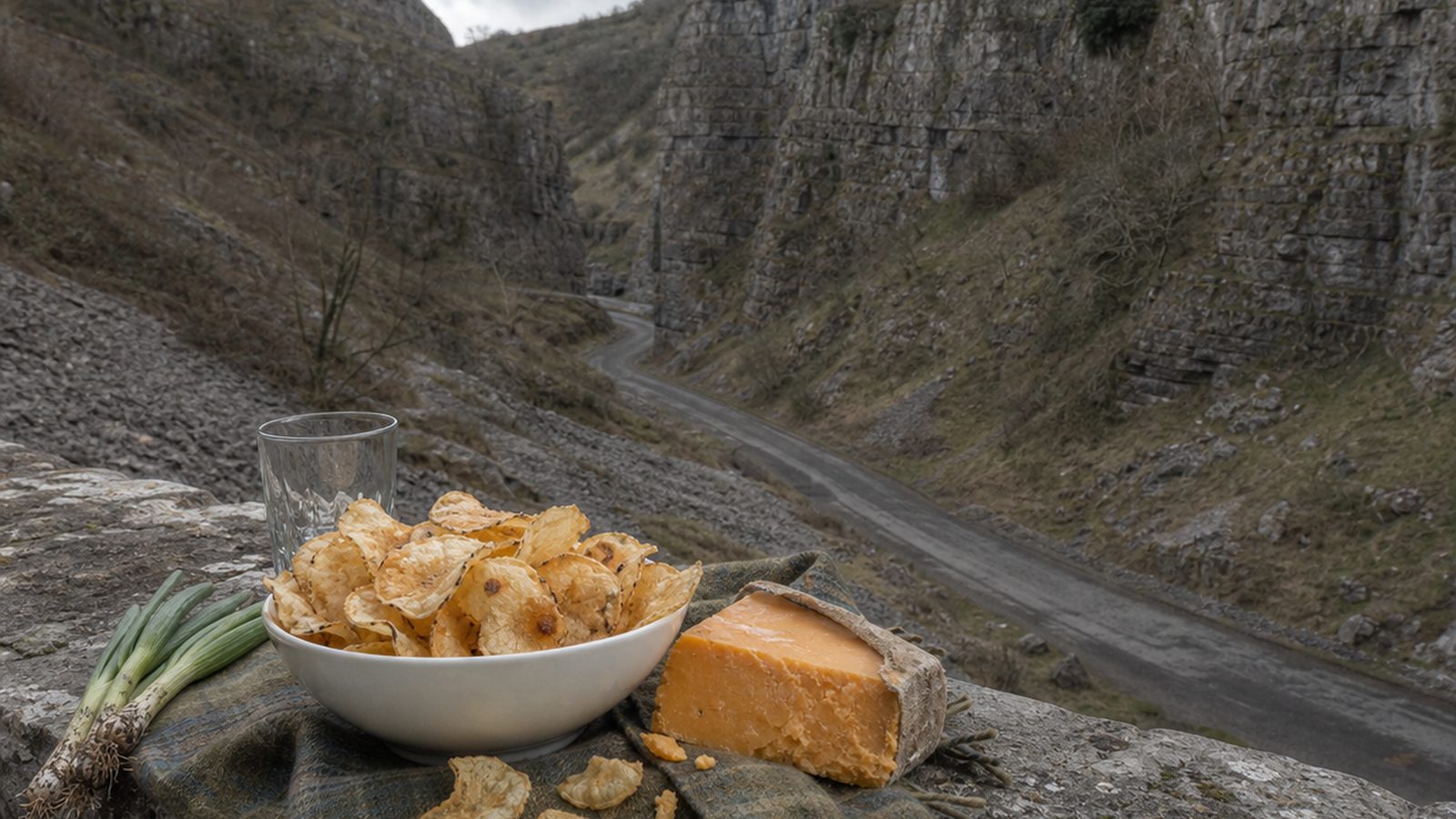
A white bowl of golden crisps flecked with dark skin, a wedge of cloth-bound cheddar and a bundle of whole spring onions on a wool rug over a stone wall, with the limestone walls of a Somerset gorge and a narrow road curving away behind under flat white sky.
Fig. IV The gorge road, and the limestone that keeps the caves at eleven degrees. Generated image
V

The dates

  1. c. 1130 Cheddar Gorge is recorded as one of the four wonders of England, forty years before the cheese itself appears in the accounts.
  2. 1170 The Pipe Roll for 1170 records Henry II buying 10,240 lb of Cheddar cheese at a farthing a pound: £10 13s 4d for 4,644 kilograms.
  3. c. 1390 The Forme of Cury, compiled by the master cooks of Richard II, calls for chibolles and porrectes — young onions — plucked small and dressed with raw oil, vinegar and salt.
  4. 1662 Thomas Fuller's Worthies of England is published, calling Cheddar cheeses the best and biggest in England, and hardly to be met with save at some great man's table.
  5. 1860 Joseph Harding publishes Recent Improvements in Dairy Practice in the Journal of the Royal Agricultural Society of England. A deputation from the Ayrshire Agriculture Association had already come to Somerset in 1854; the American dairyman Xerxes Willard followed in 1866, and Harding's son Henry carried the method to Australia.
  6. December 2006 Cheese goes into Gough's Cave, and into the cheese tunnel at Wookey Hole. Both date from that year, not from the middle ages.

Tasting notes

On the palate

  1. I

    Nutty and round, with a hint of sharpness

  2. II

    Hazelnut, which is the flavour Harding named for a good cheese

  3. III

    Green onion cut raw, not cooked

  4. IV

    A dry finish that outstays the crisp

  5. Serve

    Serve at cellar temperature. Gough's Cave sits at eleven degrees the year round, which is the local standard.

VI

Matters of record

  1. Britain's oldest near-complete human skeleton was found in the cheese cave. Cheddar Man was recovered from Gough's Cave in 1903, having died in his early twenties about ten thousand years ago. His genome carries no lactase persistence, so the cave's most famous occupant could not have digested what is now stored in it.

  2. Cheddar is not a protected name. It is not protected under UK or EU law, because it now describes a process — the stacking and turning of curd to drive out the whey — rather than a place, and anywhere on earth may make it. Only West Country Farmhouse Cheddar is protected, registered in June 1996 and confined to farms in Dorset, Somerset, Devon and Cornwall as those counties stood in 1955.

  3. The Welsh onion is not Welsh and the milkmaid did not invent Cheddar. Allium fistulosum is native to China, and Welsh here is the archaic sense of foreign. The story of the pail of milk forgotten in a cave is a myth; what farmers actually used the caves for was keeping milk cool on hot days.