Skip to content
Posh Crisps
The open boot of a dark unbadged vintage car on a wet gravel lane beside a Worcestershire hop yard, holding a wicker hamper, a tartan rug, a bowl of peppered crisps, a dark stoneware jug, a pewter beaker, a cut-glass tumbler and fresh hop cones, under low grey cloud.

Worcester, Worcestershire

Worcestershire Sauce & Cracked Pepper


No. VII of VIIIWorcestershireWorcestershire Sauce

Made by chemists, left in cask, and named for a county the makers lost in court.

Number VII of eight. The place is Worcester, Worcestershire. The earliest date on this page is 17 October 1840, and every claim after it is listed in the sources at the foot of the page.


I

Two chemists on Broad Street.

John Wheeley Lea and William Henry Perrins went into partnership on 1 January 1823 as chemists and druggists in Worcester. Their catalogue that January ran to more than three hundred items, and three of them were anchovies, tamarinds and India soy: the eventual ingredients were on the shelves fourteen years before the sauce.

By 1837 the partners held three shops in the city. That is the year the firm gives for commercialisation.

A High Court judgment of 26 July 1876 put it at about 1836. The earliest independent proof is an advertisement in the Manchester Guardian of 17 October 1840, page one, which opens by conceding the obvious: so many sauces, under every variety of name, have been of late contending for public favour, that we have hesitated to extend beyond our own vicinity the introduction of a new one.
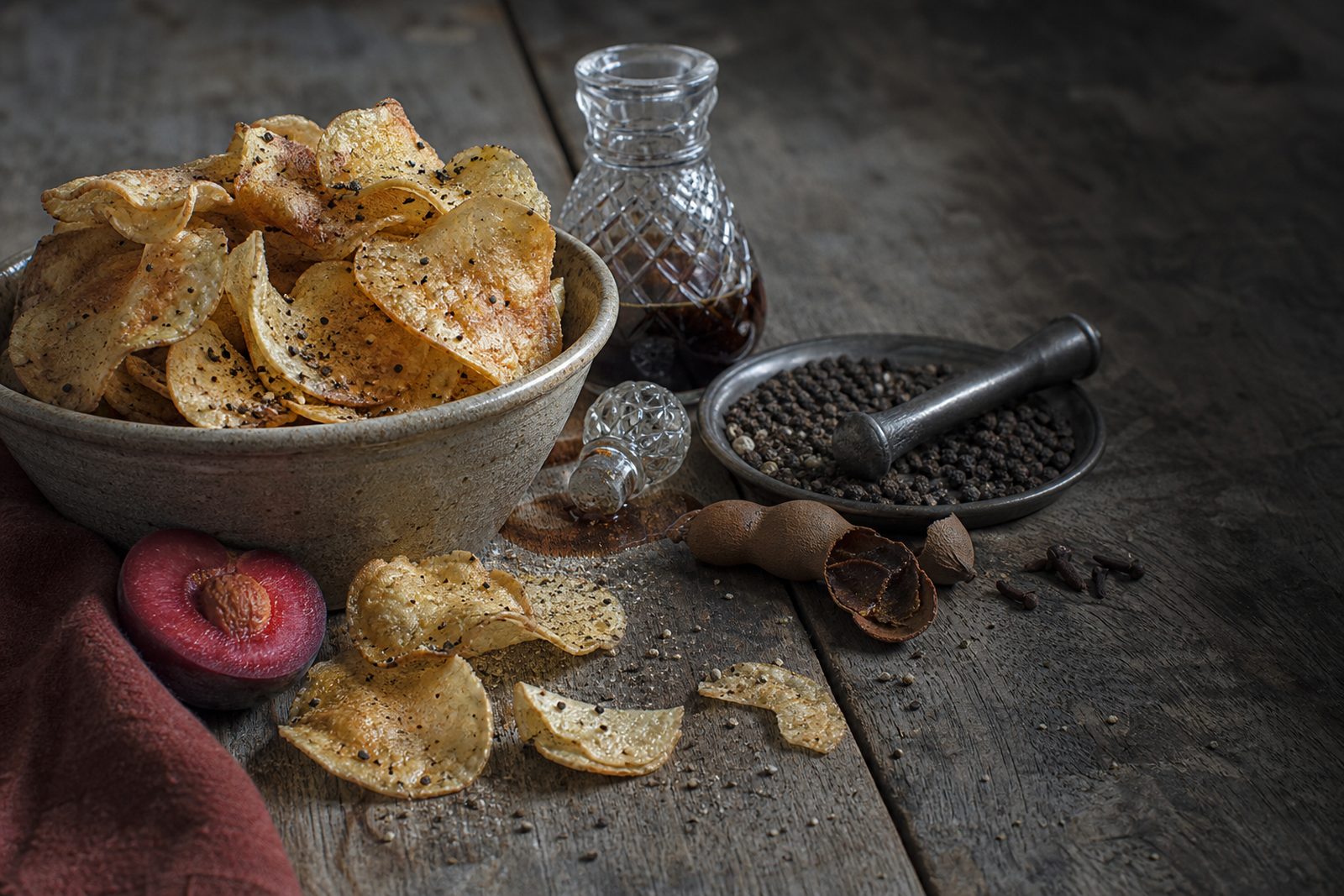
A stone bowl of crisps dusted with cracked black pepper on dark weathered boards, with a cut-crystal decanter of dark sauce, a pewter dish of peppercorns and pestle, tamarind pods, cloves, a halved plum on a dark red cloth and fallen peppered crisps in the foreground.
Fig. I A decanter of dark sauce, tamarind pods, cloves and cracked pepper. Generated image
II

The river, the brine and the vinegar.

Worcester holds the major crossing of the Severn, the longest river in Britain and by some distance the fullest in England and Wales. The tide itself stops far downstream at Gloucester, but on the biggest tides the bore reaches this far in a much reduced form, and the water at the foot of the weir at Worcester lifts a foot or so. Seven miles north-east at Droitwich the brine lies about two hundred feet down and comes up already saturated, carrying two and a half pounds of salt to the imperial gallon, ten times the strength of seawater and rivalled only by the Dead Sea.

The Romans called the place Salinae. King John granted its charter on 1 August 1215.

A few streets from the chemists' shop, two other Worcester chemists, William Hill and Edward Evans, began making malt vinegar in 1830. Their Great Filling Hall of 1850 held the largest vat in the world: thirty-nine feet high, 521,287 litres. A vinegar-heavy sauce did not appear here by accident.

Made by chemists, left in cask, and named for a county the makers lost in court.
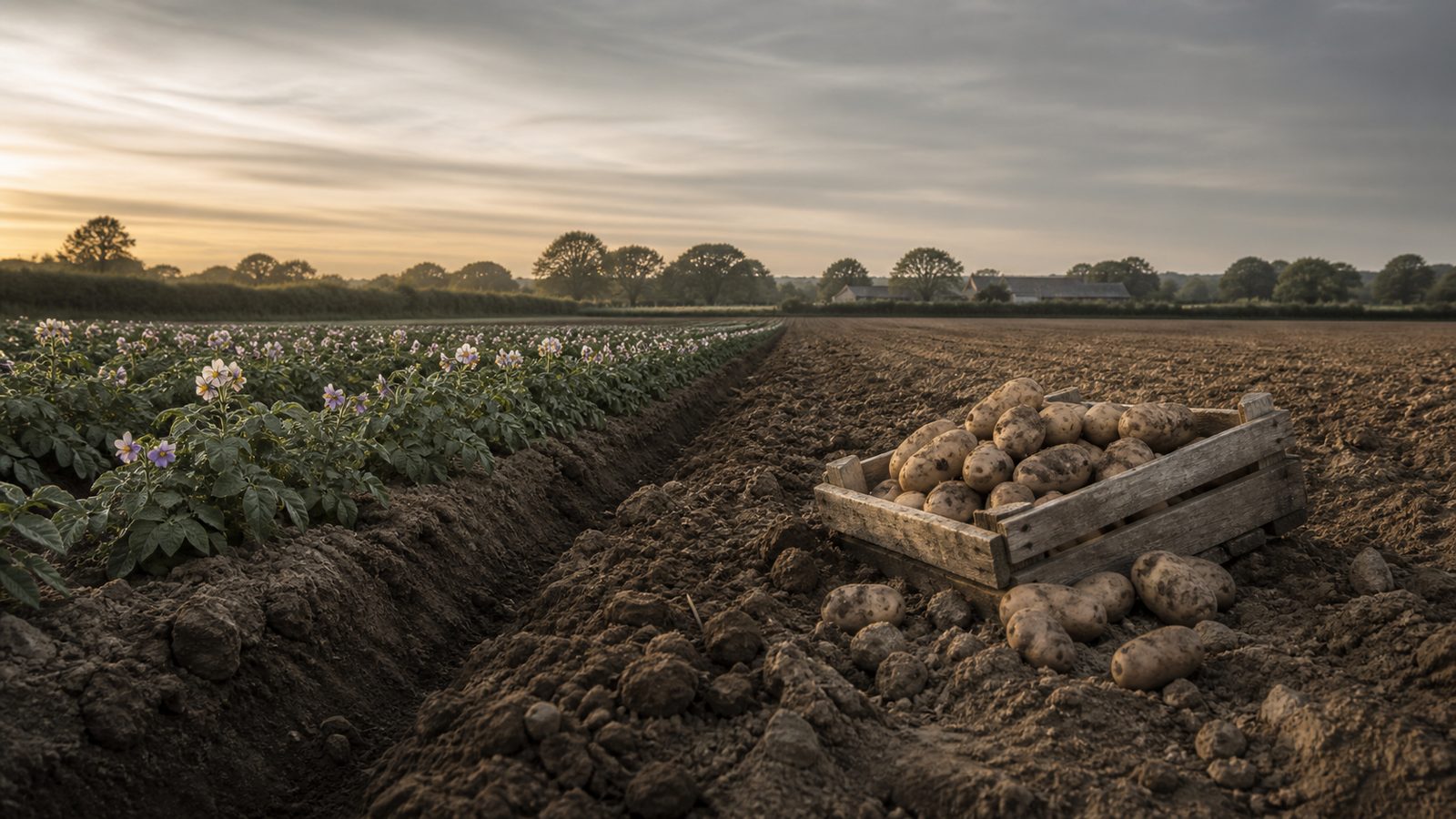
A UK potato field at dawn with rows of flowering potato plants on the left, a deep furrow of sharply detailed turned clods leading to the horizon, a weathered wooden crate of freshly lifted potatoes on bare soil at right, and hedgerow, oaks and stone farm buildings beyond.
Fig. II A potato field at first light, with the crop still in the ground. Generated image
III

Time in cask, and the cracked corn.

The sauce was never cooked. It was macerated, and then it was left alone. The Times of 8 June 1914 records the practice without ceremony: before being bottled, the sauce is allowed to mature in barrels in the cellars of the factory.

A 1970 account describes vaults of maturing barrels carrying the atmosphere of a winery, belied only by the smell of vinegar and spices, and says the sauce is matured in oak hogsheads. The familiar tale of a first batch so foul it was abandoned in the cellar and rediscovered later appears in no document before that same 1970 book, whose author thanks a Mr Lea for his assistance. Even there the barrel is only forgotten for some years; the eighteen months now always quoted was fixed on afterwards.

The ageing is documented. The anecdote is company lore. Pepper keeps its own clock: the nineteenth-century ingredient sheets list peppers by the pound, and cracked pepper tastes unlike ground because the terpenes evaporate quickly once the corn is broken and leave the piperine behind.
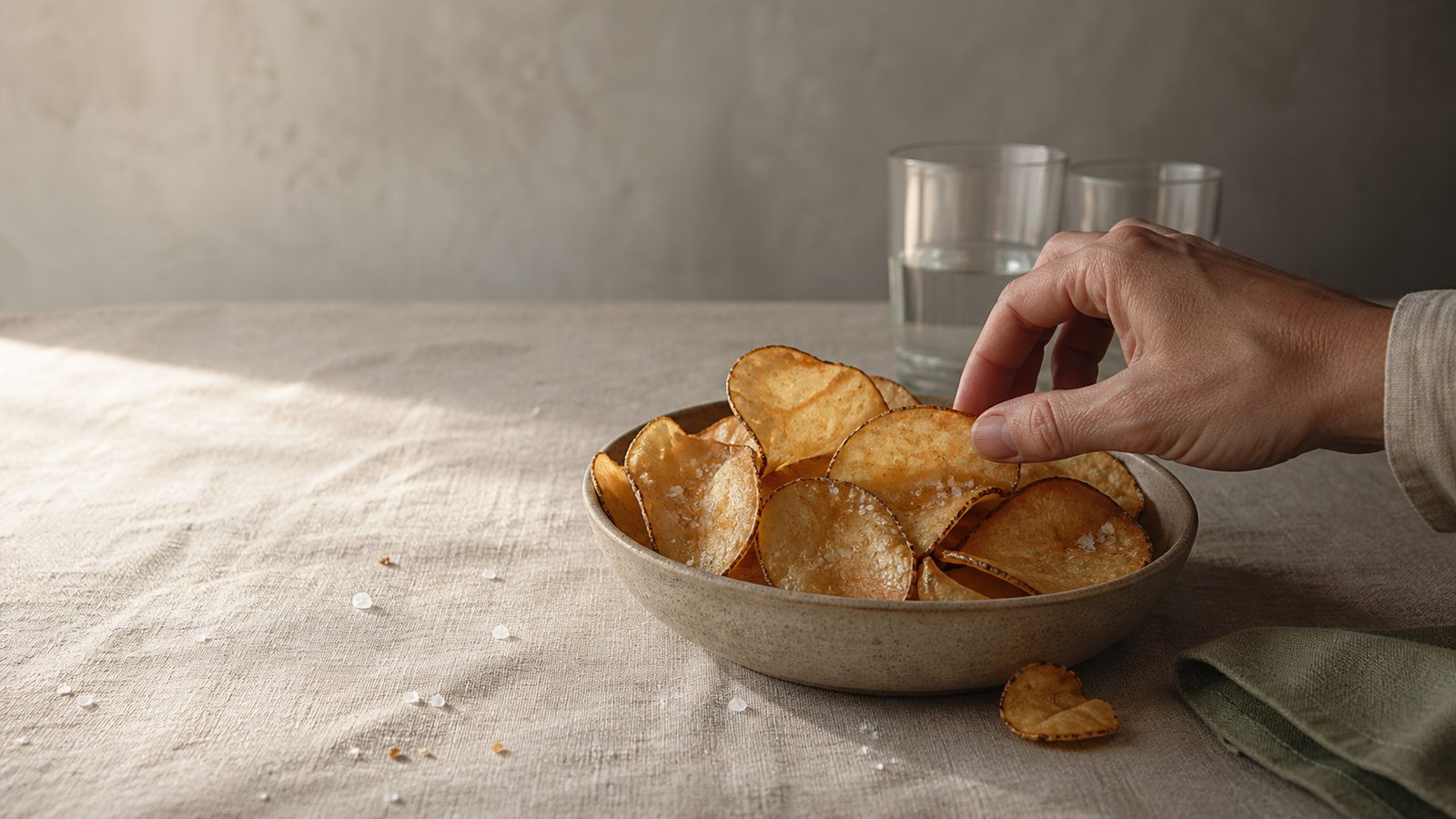
A speckled stone bowl of golden salted crisps on a sunlit linen tablecloth, a hand reaching in from the right to lift one crisp between finger and thumb, with a glass of water and two empty glasses behind and a sage-green cloth at the right edge.
Fig. III The end of the process, which takes about four seconds. Generated image
IV

The nobleman who arrived in 1884.

Everyone knows a nobleman brought the recipe home from Bengal. The name fixed to him, Lord Sandys of Ombersley Court, six miles north of the city, first reaches print on 9 February 1884, forty-four years after the first advertisement. No Baron Sandys was ever Governor of Bengal, and the historian who catalogued the firm's own surviving papers could find no record of any of them in India.

As late as 1857 Blackwood's was writing of the nobleman who had declined the immortality of the association, which is to say nobody yet had a name to print. The oldest surviving origin story is stranger and better. The novelist Mrs Grey was staying at Ombersley when Lady Sandys wished aloud for good curry powder.

Mrs Grey had a recipe in her desk, brought from India by her uncle. The chemists made up the powder. Somebody thought afterwards that it might, in solution, make a sauce.
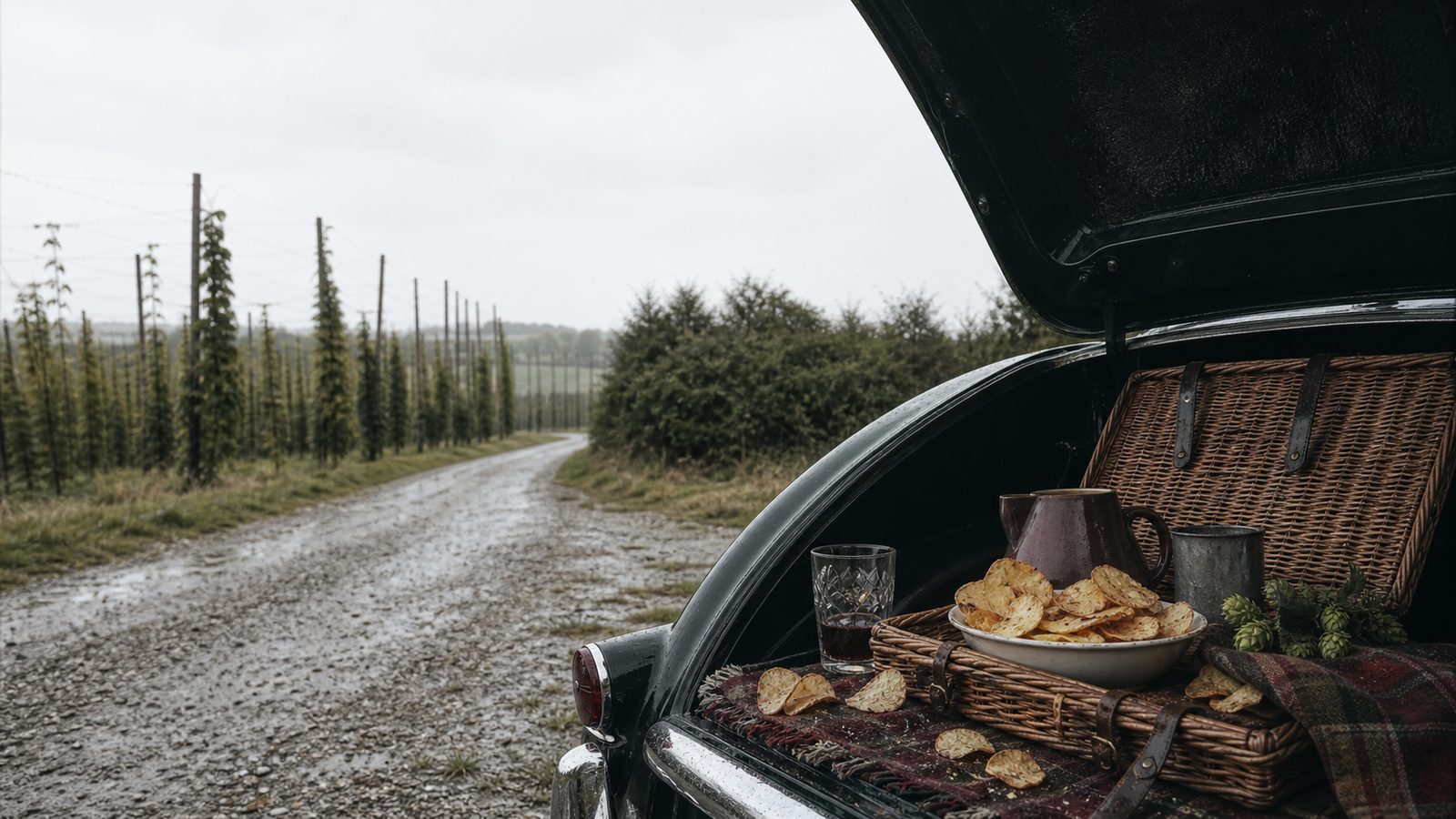
The open boot of a dark unbadged vintage car on a wet gravel lane beside a Worcestershire hop yard, holding a wicker hamper, a tartan rug, a bowl of peppered crisps, a dark stoneware jug, a pewter beaker, a cut-glass tumbler and fresh hop cones, under low grey cloud.
Fig. IV A hop yard on a wet lane, which is what Worcestershire looks like in October. Generated image
V

The dates

  1. 1823 Lea and Perrins enter partnership on 1 January as chemists and druggists on Broad Street, Worcester. Their catalogue already lists anchovies, tamarinds and India soy.
  2. 1830 Hill, Evans & Co, founded by two more Worcester chemists, begin making malt vinegar in the centre of the city. Expansion later carries them to a six-acre site at Lowesmoor and the largest vinegar works in the world.
  3. 1840 The earliest known advertisement, Manchester Guardian, 17 October, page one, signed Lea, Perrins, & Smith, Worcester and Cheltenham.
  4. 1845 Hand-filling in the back of the shop ends and a manufactory opens in Bank Street. A London warehouse follows the same year.
  5. 1851 The sauce enters printed cookery for the first time, in Alexis Soyer's The Modern Housewife, recipe 181, wild fowl sauce.
  6. 1876 The High Court rules on 26 July that Worcestershire has become a common name in the trade. It has been generic ever since.

Tasting notes

On the palate

  1. I

    Tamarind and anchovy, low and savoury

  2. II

    Malt vinegar sharpness over molasses

  3. III

    Onion and clove behind it

  4. IV

    Pepper arriving last, with its terpenes intact

  5. Serve

    At a window over the Severn in February, when the water is where the lawn used to be. The worst flood the city has recorded was in 1670, and the July 2007 water came closest to it, so the practice has a long precedent. A glass of tomato juice is permitted, on the grounds that the pairing was somebody else's idea and has had a century to establish itself.

VI

Matters of record

  1. The oldest surviving advertisement is signed Lea, Perrins, & Smith, Worcester and Cheltenham. Two hundred pages of collected sources on the sauce record nothing further about Mr Smith, who appears once and then leaves the story.

  2. For roughly a century the secret ingredient was soy sauce. Where it came from is less certain, though an 1881 account of the trade reports that most of the soy made at Canton was shipped to England to be used as a base for sauces. Supply failed in the Second World War and hydrolysed vegetable protein replaced it permanently, a change confirmed in writing by the factory's own general manager in 1991. A great many people first tasted soy without ever being told.

  3. The largest vinegar vat in the world stood in Worcester: twelve metres high, 521,287 litres, inside the Great Filling Hall of 1850. Most of the works was demolished, but the hall was listed Grade II in 1974 and still stands.