Skip to content
Posh Crisps
A white bowl of pale crisps on a frost-touched grey rug over a stone wall, with a wedge of blue-veined Stilton on a small dish, two pears and a blue-banded stoneware jug, above misted parkland with avenues of bare trees and a distant country house on the ridge.

Melton Mowbray, Leicestershire

Blue Stilton & Pear


No. VI of VIIILeicestershireBlue Stilton

A cheese named for a village that is now forbidden to make it.

Number VI of eight. The place is Melton Mowbray, Leicestershire. The earliest date on this page is Noted 1722, and every claim after it is listed in the sources at the foot of the page.


I

A village on the Great North Road.

Stilton sits on Ermine Street, the Roman road that later carried the Great North Road. Its two principal inns were the Bell, recorded from 1515 and rebuilt in 1642, and the Angel, early seventeenth century and rebuilt as a red brick house in the eighteenth. At its height the village kept fourteen public houses for a population of about five hundred.

Cooper Thornhill, a corn merchant, took the Bell in 1730 and bought the Angel opposite in 1743 for £850, which gave him both sides of the road and the cheese trade passing along it. The Angel stabled three hundred horses and kept its own farriers and blacksmiths.

An illustration of about 1840 shows Stilton cheese going into the boot of a coach at the Bell, in among the luggage and a brace of mallard. The Wadesmill to Stilton stretch, authorised by an Act of 1663, was the first turnpike road in England. The cheese travelled the prototype of the toll road.
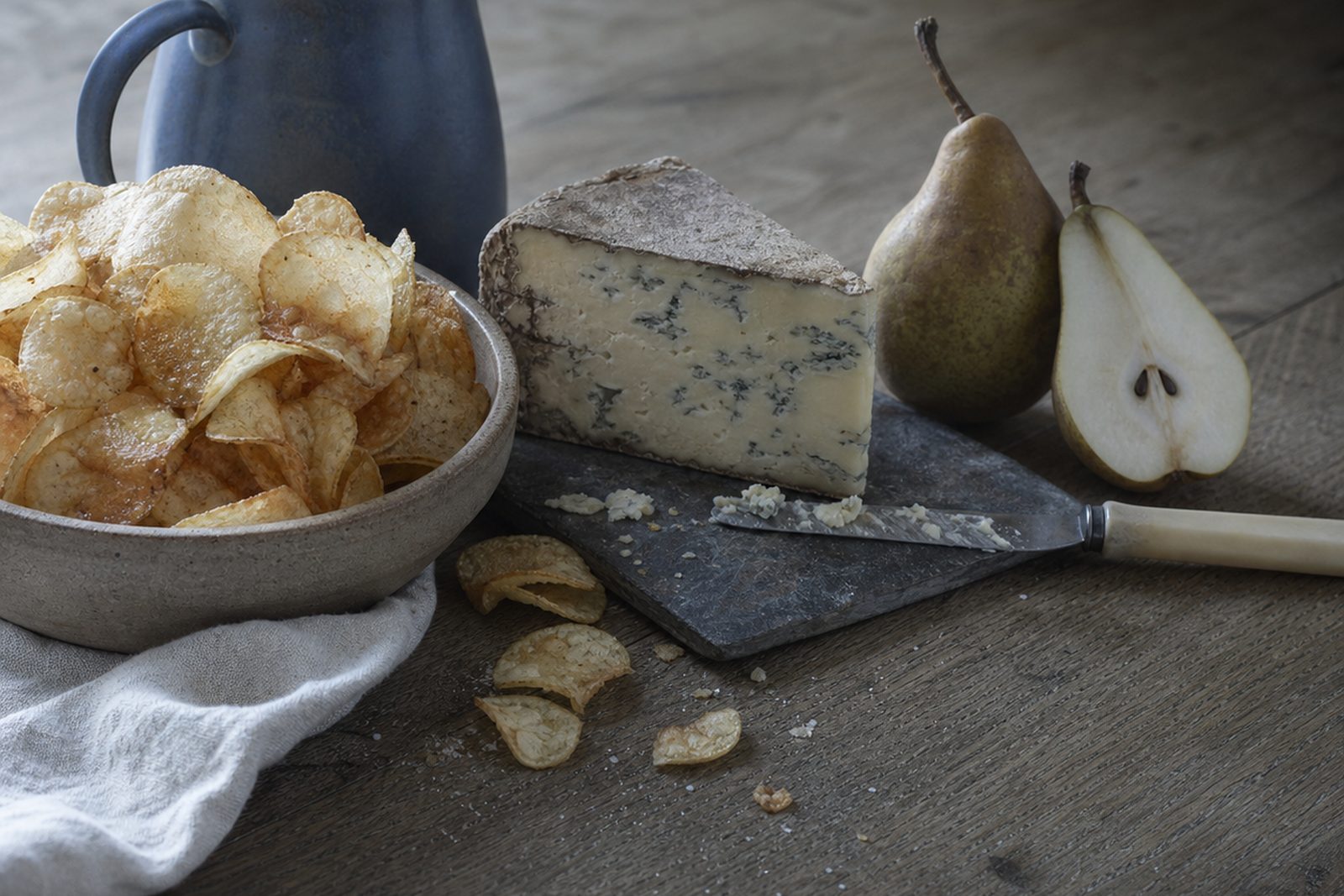
A stone bowl of thin cupped crisps beside a blue stoneware jug on a grey wooden table, with a crusted wedge of blue-veined Stilton on a slate board, a bone-handled knife carrying crumbled cheese, a whole pear and a halved pear, and fallen crisps on the boards below.
Fig. I A crusted wedge of blue-veined cheese, and two pears. Generated image
II

The argument, and its paperwork.

The Stilton Cheesemakers' Association holds that the cheese was first made in the country around Melton Mowbray and never in the village of Stilton at all. The documentary record is less obliging. The earliest known printed reference is William Stukeley's, in an entry dated October 1722 and published in his Itinerarium Curiosum of 1724.

Richard Bradley printed a recipe for the famous Stilton cheese in a series of monthly articles in 1721 and 1722, later gathered into his General Treatise of Husbandry and Gardening of 1726. His informant was the horticulturalist John Warner, who noted that the man at the sign of the Bell kept strictly to the old receipt, while others thereabouts seemed to leave out a great part of the cream. That is more than one maker in the neighbourhood, working to something already old.

The Compleat Grazier of 1776 gives the cheese at eighteen pounds, sold at twelve pence a pound by all that make it in Stilton, though the same author adds that only one house there still followed the true method. Richard Landy has set the two accounts against each other document by document. The question is not settled, and we are not going to settle it here.

A cheese named for a village that is now forbidden to make it.
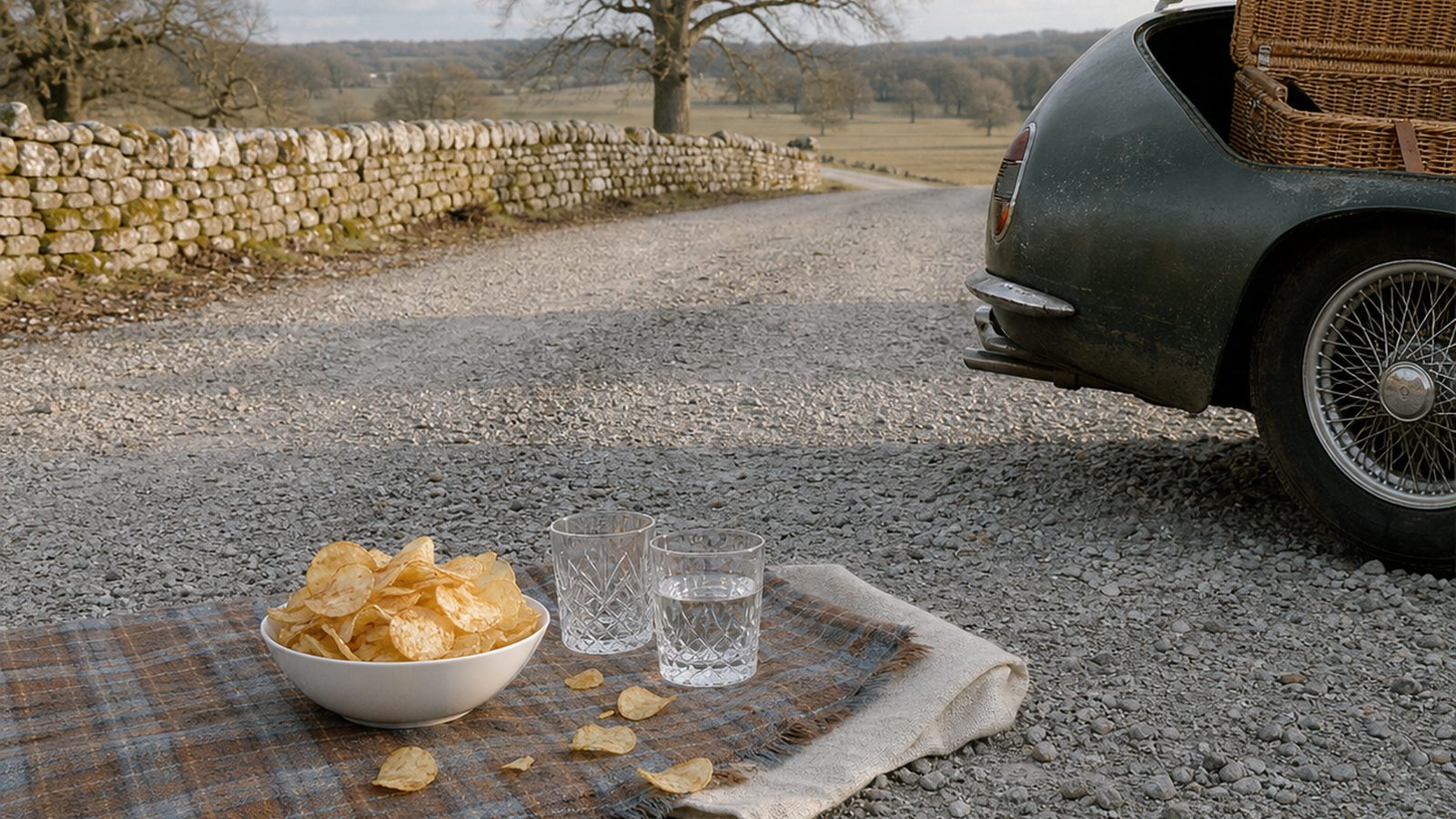
A white bowl of crisps and two cut-crystal tumblers of water on a tartan rug spread over a gravel drive, with fallen crisps on the wool, and the unbadged rear wing, wire wheel and wicker-loaded boot of a dark green vintage sports car at the right beside a dry stone wall.
Fig. II Gravel, wool and an open boot. The English picnic is a weather event. Generated image
III

Clay, grass and the Vale of Belvoir.

The Vale of Belvoir is floored by the mudstones of the Lias. Heavy wet ground favours grass over reliable corn, and permanent pasture is what a milking herd requires.

The south-eastern edge rises in a scarp capped by resistant Jurassic Marlstone ironstone, which is why Belvoir Castle stands about a hundred metres above the valley floor and the Vale reads as a bowl. Enclosure turned open field into hedged permanent pasture. Robert Bakewell of Dishley Grange, born 1725, worked out systematic selective livestock breeding in the same county later in the same century.

A dozen Vale farmers formed the Long Clawson dairy in 1911; Colston Bassett opened its dairy in 1913. Melton Mowbray took the by-product, or so the usual account runs: dairying makes whey, whey fed pigs, and the pigs gave the town its pork pie.
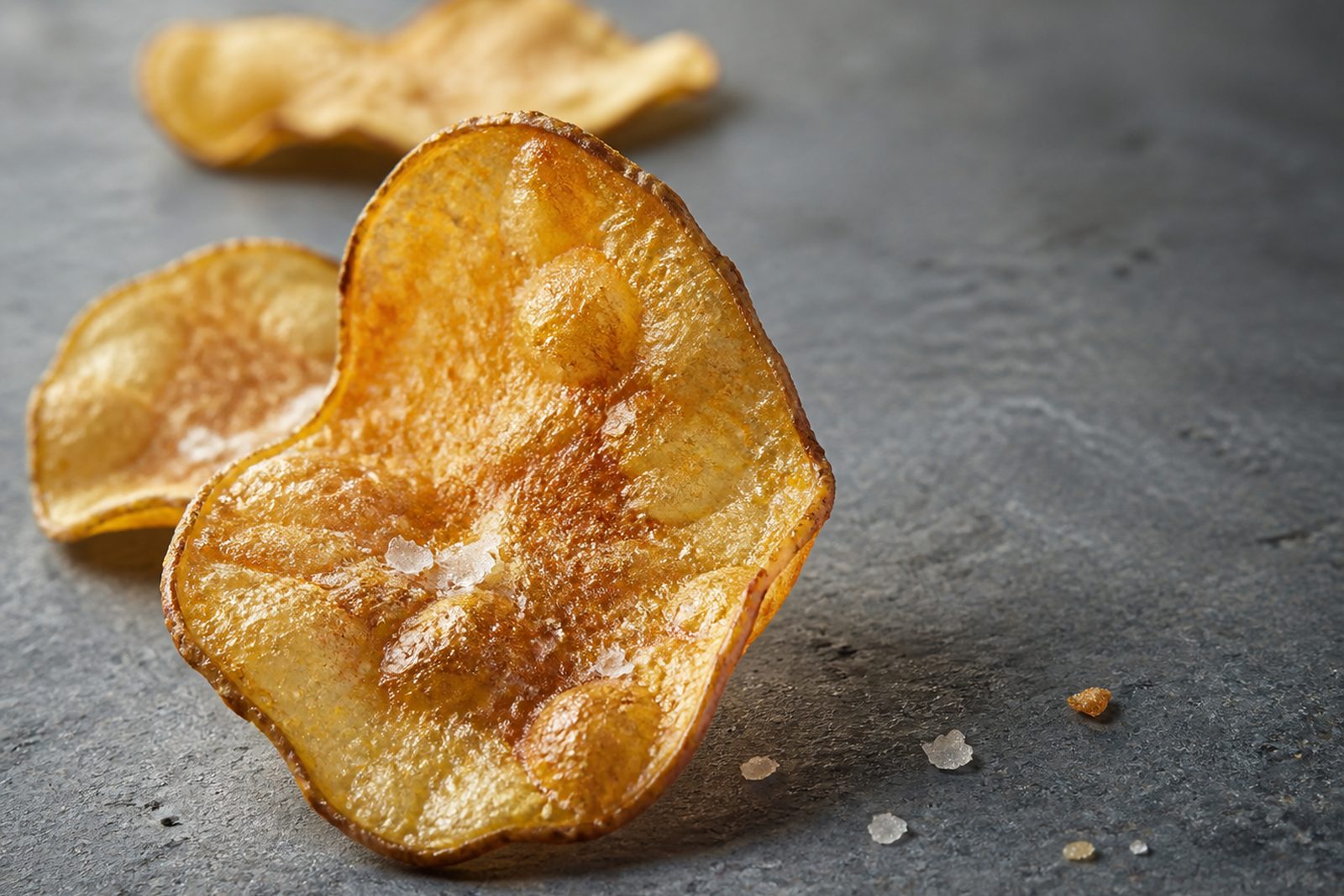
Extreme close-up of a single golden hand-cooked crisp standing on grey slate, its surface covered in irregular blistered domes and a rippled darker-flecked rim, with coarse salt crystals embedded in the oil and two softly out-of-focus crisps behind it.
Fig. III One crisp at close range. The blistering is what frying does to starch. Generated image
IV

The pear has no Leicestershire claim.

It should be said plainly: the pear did not come from here, and the pairing is not old. The Romans brought pears to Britain. Medieval England grew the warden, a pear that never truly ripens and has to be cooked, first noted at the Cistercian abbey of Warden in Bedfordshire in the thirteenth century, with the Black Worcester recorded growing there by 1388.

It kept through winter without refrigeration and travelled without complaint. Shakespeare has warden pies in The Winter's Tale. The perry counties lie west of here, and Gloucestershire alone held more than a hundred varieties of perry pear under more than two hundred local names.

Conference, now about nine tenths of the British pear crop, was raised by Thomas Rivers at Sawbridgeworth in Hertfordshire and named for the National British Pear Conference held in London in 1885, where it took first prize. Cheese and pear is a modern cheeseboard convention. It is set down here as one.
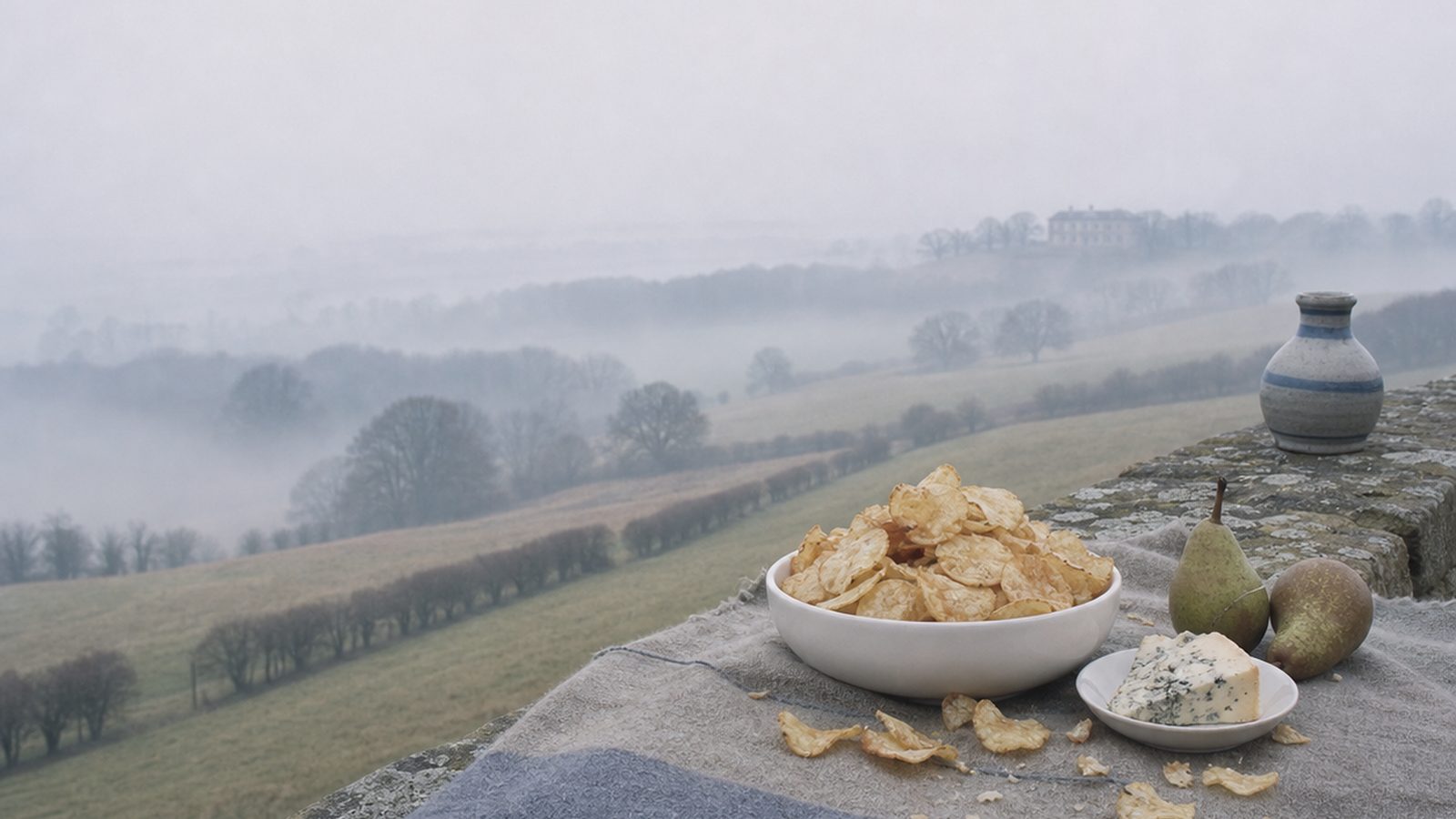
A white bowl of pale crisps on a frost-touched grey rug over a stone wall, with a wedge of blue-veined Stilton on a small dish, two pears and a blue-banded stoneware jug, above misted parkland with avenues of bare trees and a distant country house on the ridge.
Fig. IV Misted parkland in the Vale of Belvoir, with the avenues bare. Generated image
V

The dates

  1. 1663 The Wadesmill to Stilton road is authorised as England's first turnpike, putting a toll gate on the route the cheese would travel.
  2. 1722 William Stukeley notes Stilton cheese in an entry dated October, printed in his Itinerarium Curiosum of 1724. It is the earliest known reference in print.
  3. 1730 Cooper Thornhill acquires the Bell at Stilton; he buys the Angel opposite in 1743 for £850.
  4. 1911 A dozen farmers of the Vale of Belvoir form the Long Clawson dairy. Colston Bassett follows in 1913.
  5. 1936 The Stilton Cheesemakers' Association is formed to lobby for regulation of the cheese's quality and origin.
  6. 1996 Protected designation of origin is granted. Only Derbyshire, Leicestershire and Nottinghamshire may make Stilton.

Tasting notes

On the palate

  1. I

    Cream and salt, then the blue

  2. II

    Mineral rather than sharp

  3. III

    Pear sweetness arriving late

  4. IV

    Finishes dry

  5. Serve

    Out of the cold two hours before it is wanted, and port in a glass beside it. Scooping a hollow in the top and pouring the port into that is the famous version, and the trade deprecates it; this has not stopped anyone selling the two ready mixed in a screw-top tube. Pear thinly sliced, on the side, not on top.

VI

Matters of record

  1. Richard Landy reports excavating a complete third-century Roman cheese mould in the village, on his account the only complete example ever found, along with fragments of several more. If he is right, cheese was being made at Stilton some seventeen hundred years ago.

  2. Frances Pawlett of Wymondham is widely credited with inventing Stilton. Landy gives her birth year as 1720, by which point the cheese was already being written about as famous. She may well have standardised its shape and method. She cannot have originated it.

  3. Stilton village cannot legally make Stilton, because it lies in Cambridgeshire, outside the three protected counties. The Original Cheese Company applied to Defra to have the protected area amended to take the village in; the application was rejected in 2013.