Skip to content
Posh Crisps
A pewter salver of irregular blistered crisps and a brown salt-glazed jug standing on a mossy stone balustrade high above a Yorkshire dale, with a limestone scar, dry stone walls and a rain squall crossing the far hillside, and a plain glass of malt vinegar beside the jug.

Yorkshire

Malt Vinegar & Sea Salt


No. II of VIIIYorkshireMalt Vinegar

Beer, soured on purpose, and a county that made a trade of it.

Number II of eight. The place is Yorkshire. The earliest date on this page is 1341 — two brewhouses taxed at Tadcaster, and every claim after it is listed in the sources at the foot of the page.


I

One dead sea, two ingredients.

The Zechstein was a sea. It dried out at the end of the Permian, roughly 257 to 251 million years ago, in at least five cycles of evaporation, and left its salt behind in a belt running from the east coast of England to northern Poland.

Two things here come out of it. In 1859 a borehole was sunk at Bolckow and Vaughan's Middlesbrough ironworks in search of clean boiler water, the Tees being no use for it. In 1862, at about 1,200 feet, it struck a bed of rock salt some 100 feet thick.

Middlesbrough was then in the North Riding of Yorkshire and remained so until 1968. Where the same beds reach the surface — a belt running from Nottingham north through Yorkshire and into County Durham — they are called the Magnesian Limestone, and the water that comes up through them is hard and rich in gypsum, which makes very good beer.
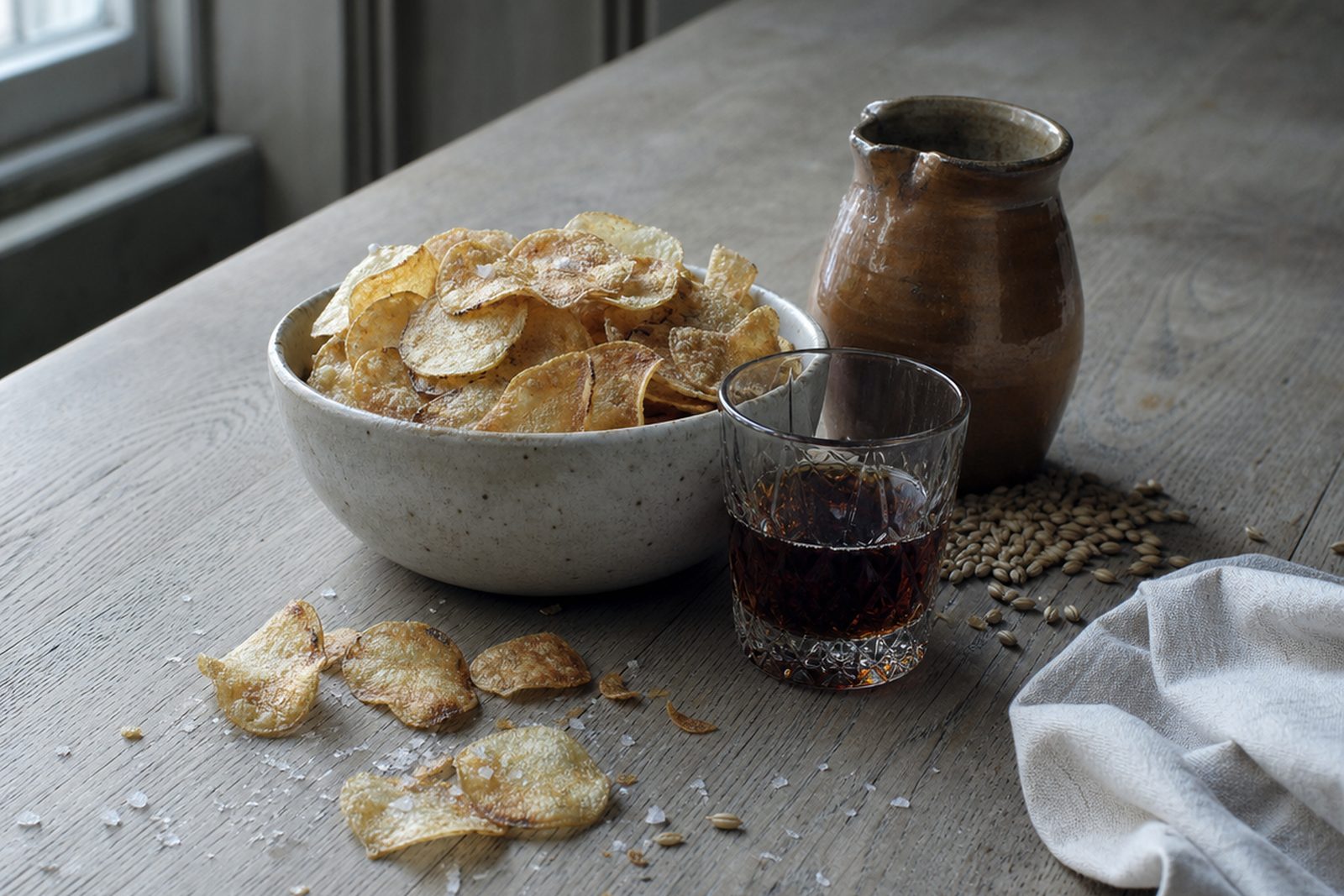
A speckled stone bowl piled with thin salted crisps on a pale scrubbed table beside a cold window, with a brown salt-glazed jug, a cut-crystal tumbler of dark malt vinegar, loose barley grains, a linen cloth and fallen crisps and salt scattered across the wood.
Fig. I Barley, a salt-glaze jug and a tumbler of dark malt vinegar. Generated image
II

Barley, and the patience it takes.

Tadcaster sits on that limestone. The Romans called the place Calcaria, after the lime. Tax registers of 1341 record two brewhouses working in the town, one paying 8d in tax and the other 4d, and springs still rise near St Mary's church that local usage calls popple-wells.

Samuel Smith's Old Brewery was founded in 1758 and claims to be the oldest in Yorkshire; the well sunk that year still draws water from eighty-five feet down. At Castleford, Thomas Fawcett & Sons has malted barley on the same site since 1809. Malting is slow work.

The grain is steeped, couched, spread across a floor and turned for a fortnight, and stopped before the shoot bursts the husk. Then it is kilned for two to four days. Warm weather hinders germination, so many maltings worked only in winter, in long low buildings of no more than two storeys.

Beer, soured on purpose, and a county that made a trade of it.
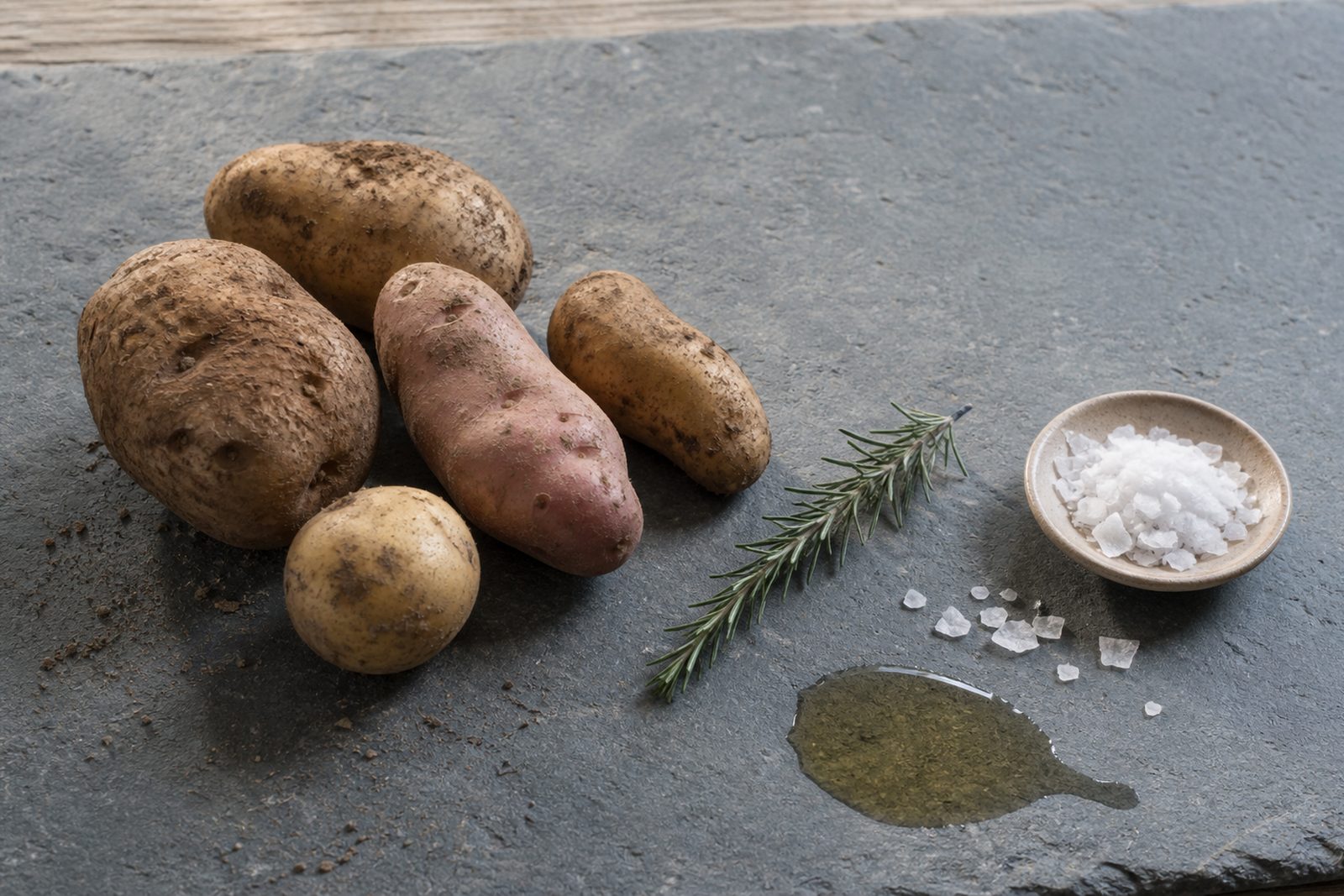
Five unwashed heritage potatoes with soil in their eyes, one pink-skinned, grouped on a honed grey slate slab over weathered oak, beside a rosemary sprig, a shallow spill of oil, scattered flake salt crystals and a small unglazed dish heaped with sea salt.
Fig. II Unwashed potatoes, oil and salt. Everything before the decision. Generated image
III

Alegar.

Malt vinegar entered English as alegar: ale, plus the French aigre, sour — the same second half as in vinegar. The word is recorded from about 1500, alongside beeregar, and despite the name the stuff was mainly brewed from sour beer rather than ale.

There was no shortage of feedstock. The average person in medieval England drank something like a litre of ale a day, and what turned was not thrown out. Alegar was a fierce product, far harsher than wine vinegar, and its first job was preservation rather than seasoning.

It went into the crock with salt and spices. Malt vinegar and salt arriving together on a plate is the late end of a five-hundred-year-old pairing.
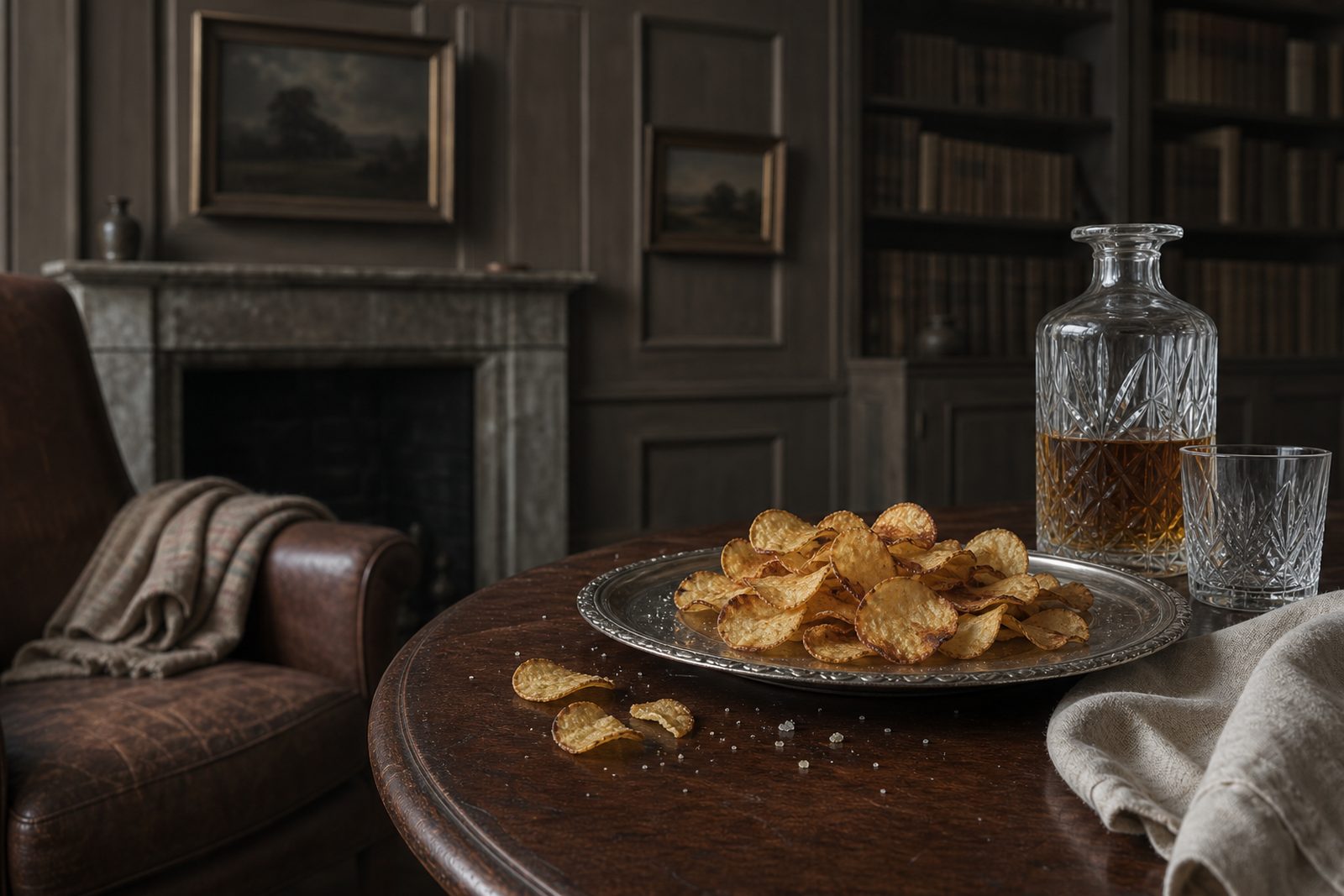
A silver salver of thin blistered crisps on a polished round table in a panelled country-house library, with a cut-crystal decanter of whisky and a tumbler, a leather armchair and folded blanket by a stone fireplace, dark landscape paintings and shelved books behind.
Fig. III A room with a fire in it, which is the intended setting. Generated image
IV

Elland Road, and what it was for.

Yorkshire did not only pour the stuff. The Cambrian Vinegar Company, of Pontypridd, opened a Leeds branch in 1865, in a cellar in New Briggate, moved to a former wool warehouse on Water Lane in Holbeck in 1868, and in 1877 into a purpose-built vinegar brewery on Elland Road.

Fifty staff, two steam engines, four-thousand-gallon vats, thirty-five to forty thousand gallons a week. Vinegar breweries were rare enough that Elland Road and the Penistone Company at Barnsley between them could supply all of Yorkshire, the North and South Midlands and southern Scotland. It closed in the 1960s and was demolished.

The trade it fed keeps its headquarters nearby: the National Federation of Fish Friers, founded in 1913, is run from Meanwood in Leeds. And at Guiseley in 1931, three years after opening a wooden hut there, Harry Ramsden moved into new premises and put chandeliers, oak panelling and fitted carpets around a fried fish counter.
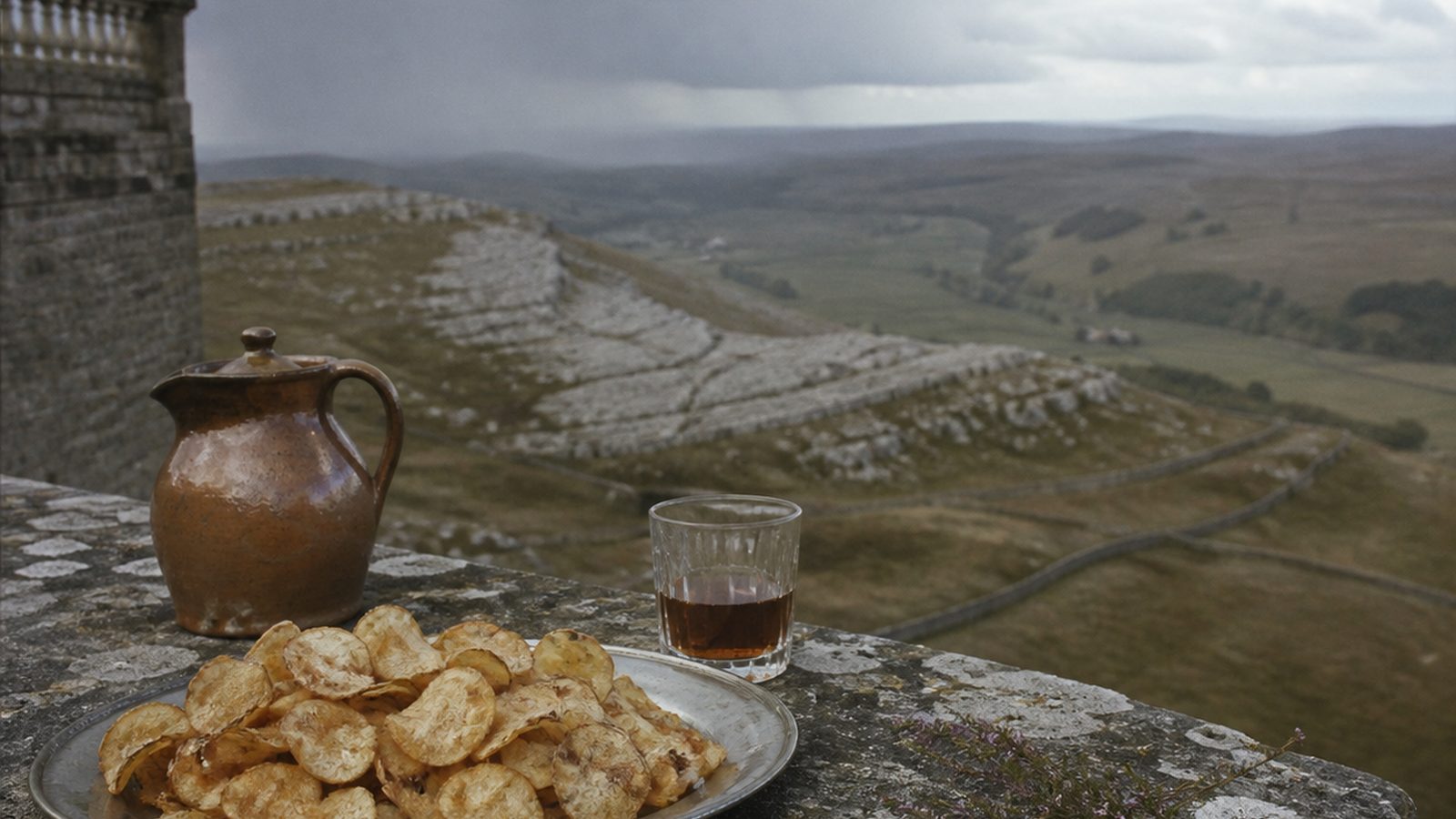
A pewter salver of irregular blistered crisps and a brown salt-glazed jug standing on a mossy stone balustrade high above a Yorkshire dale, with a limestone scar, dry stone walls and a rain squall crossing the far hillside, and a plain glass of malt vinegar beside the jug.
Fig. IV A limestone scar, dry stone walls, and a rain squall crossing the dale. Generated image
V

The dates

  1. 1341 Tax registers record two brewhouses working at Tadcaster.
  2. c.1500 Alegar — ale plus the French aigre, sour — is first recorded in English.
  3. 1758 Samuel Smith's is founded at Tadcaster; its well still draws from eighty-five feet.
  4. 1862 A borehole beneath Middlesbrough, then North Riding of Yorkshire, strikes rock salt at about 1,200 feet.
  5. 1877 The Cambrian Vinegar Company opens a purpose-built vinegar brewery on Elland Road, Leeds.
  6. 1913 The National Federation of Fish Friers is founded; it is run from Leeds today.

Tasting notes

On the palate

  1. I

    Dark malt, sharp on landing

  2. II

    A clean sour that keeps going

  3. III

    Salt arriving second

  4. IV

    A finish of steam and newspaper

  5. Serve

    Eat out of doors, standing up, in poor weather. This flavour was assembled on a wet pier and has never performed as well indoors.

VI

Matters of record

  1. Much of the vinegar on a British chip shop counter is legally not vinegar. Non-brewed condiment is water, acetic acid, flavourings and usually caramel colour; in a 1949 prosecution at Bow Street Magistrates' Court the Chief Metropolitan Magistrate ruled that calling it non-brewed vinegar was a false trade description under the Merchandise Marks Act 1926, the appeal to the King's Bench Division failed, and the trade renamed it. Trading Standards guidance is that it may not be labelled as vinegar, nor put out in a traditional vinegar bottle.

  2. The salt and the vinegar are geological siblings. The same vanished Permian sea laid down the rock salt beneath Teesside and Boulby and the Magnesian Limestone whose hard, gypsum-rich water made Yorkshire's bitter beers — and therefore the beer that sours into malt vinegar.

  3. Malt vinegar is not naturally that colour. Brewed from malt it comes out light brown, and the depth on the shelf is topped up afterwards — Sarson's does it with barley malt extract, other vinegars with caramel, which is also what gives non-brewed condiment its convincing shade.