Skip to content
Posh Crisps
A silver salver heaped with thin blistered crisps on a grey tartan rug, resting on a lichened stone parapet above an Essex saltmarsh, with a small clinker boat grounded on the mud beside a winding tidal creek and a bank of flat grey cloud filling the upper half of the frame.

Maldon, Essex

Sea Salt & Cider Vinegar


No. I of VIIIEssexSea Salt

Salt on one estuary since the Iron Age, with a gap in the middle that nobody mentions.

Number I of eight. The place is Maldon, Essex. The earliest date on this page is c. 400–100 BC, and every claim after it is listed in the sources at the foot of the page.


I

The marsh was the first refinery.

Seawater is about 3.5 per cent salt, which is a poor place to start. The people working this coast in the Bronze and Iron Ages improved on it before they lit anything. Over three hundred red hills have been identified, mostly along the Essex and Norfolk coasts, with others in Suffolk and Kent; in Essex they cluster around the Dengie peninsula and Maldon, and around the Blackwater and Colne estuaries.

Archaeologists accepted the link to salt long before anyone could say what the mounds were actually made of. Excavation at Stanford Wharf, on the Essex bank of the Thames, settled it: fuel ash from burnt saltmarsh plants, harvested with the marsh sediment still adhering. Sea rush, sea plantain, sea lavender and thrift take up and hold salt as they grow. Burn them and the ash is saline.

Stir that ash back into seawater and the brine gets stronger. Essex helps too: around 600 millimetres of rain a year, in the shadow of the western uplands that strip the Atlantic air before it arrives. Brine that is not being rained on concentrates cheaply.
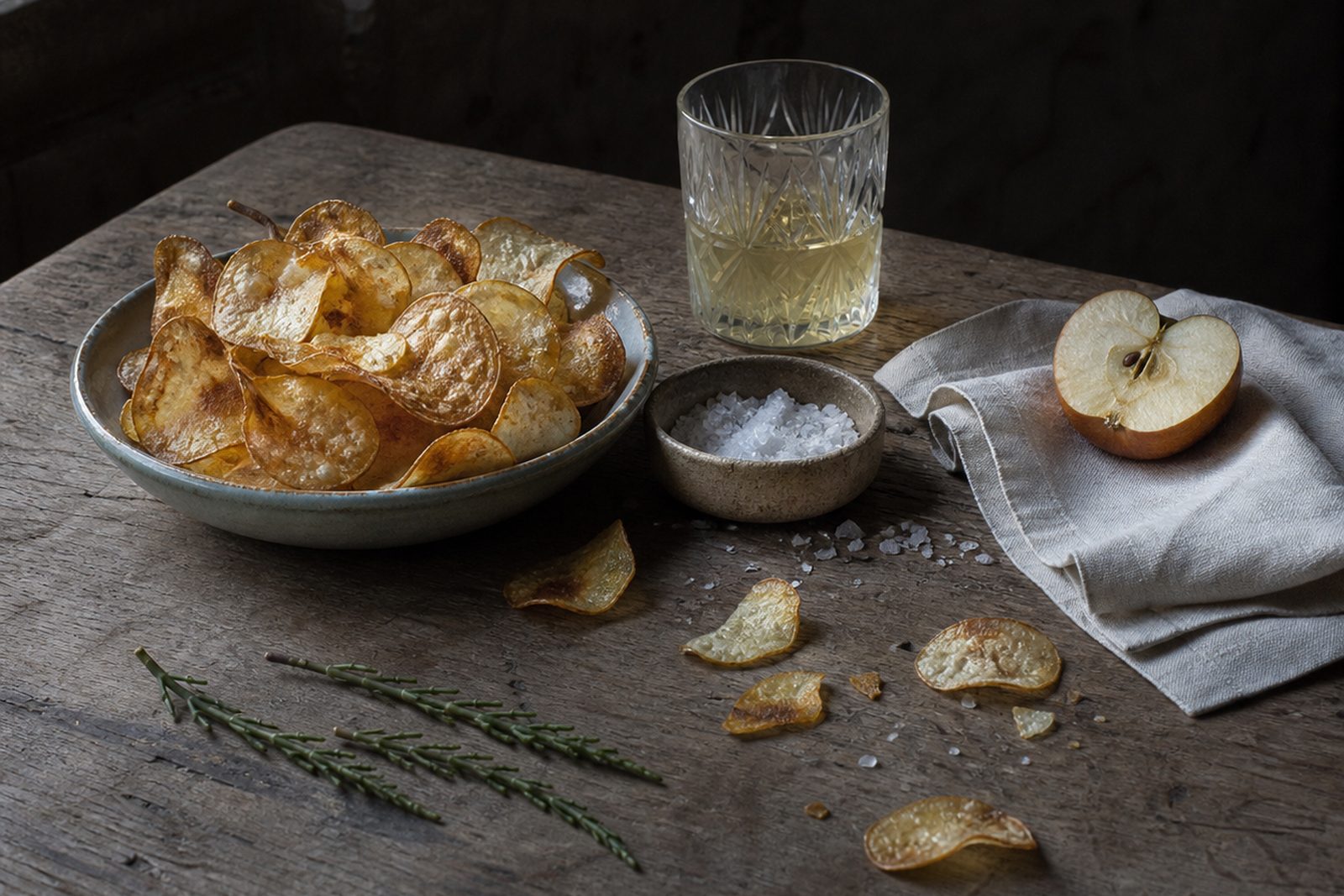
A pale stoneware bowl of thin cupped crisps on a worn oak table, with a cut-crystal tumbler of cider vinegar, a small salt-glaze dish heaped with flake salt, a halved apple on folded linen, a sprig of samphire and several broken crisps and salt crystals scattered across the boards.
Fig. I Flake salt, cider vinegar and samphire, on a table that has been scrubbed. Generated image
II

Rome, and something sour.

The Iron Age method survived the conquest and ran on into the fourth century. From about AD 250 the Stanford Wharf site was reorganised around four salterns, and traces of lead in two of them turned lead evaporating pans in Essex from conjecture into evidence. In a late Roman ditch on the same site lay a mass of tiny fish bones — juvenile herring, sprat and smelt — dumped in quantities that indicate fish sauce, liquamen or allec, made beside the salt that preserved it.

Nowhere else in Britain is the association with a salt-works so clear. Earlier in the Roman period a timber structure with an apsidal end had stood at the edge of the palaeochannel, probably a boathouse.

Salt and a sharp fermented liquid, produced together on Essex mud, eighteen centuries ago. It was not cider vinegar. It was the same idea.

Salt on one estuary since the Iron Age, with a gap in the middle that nobody mentions.
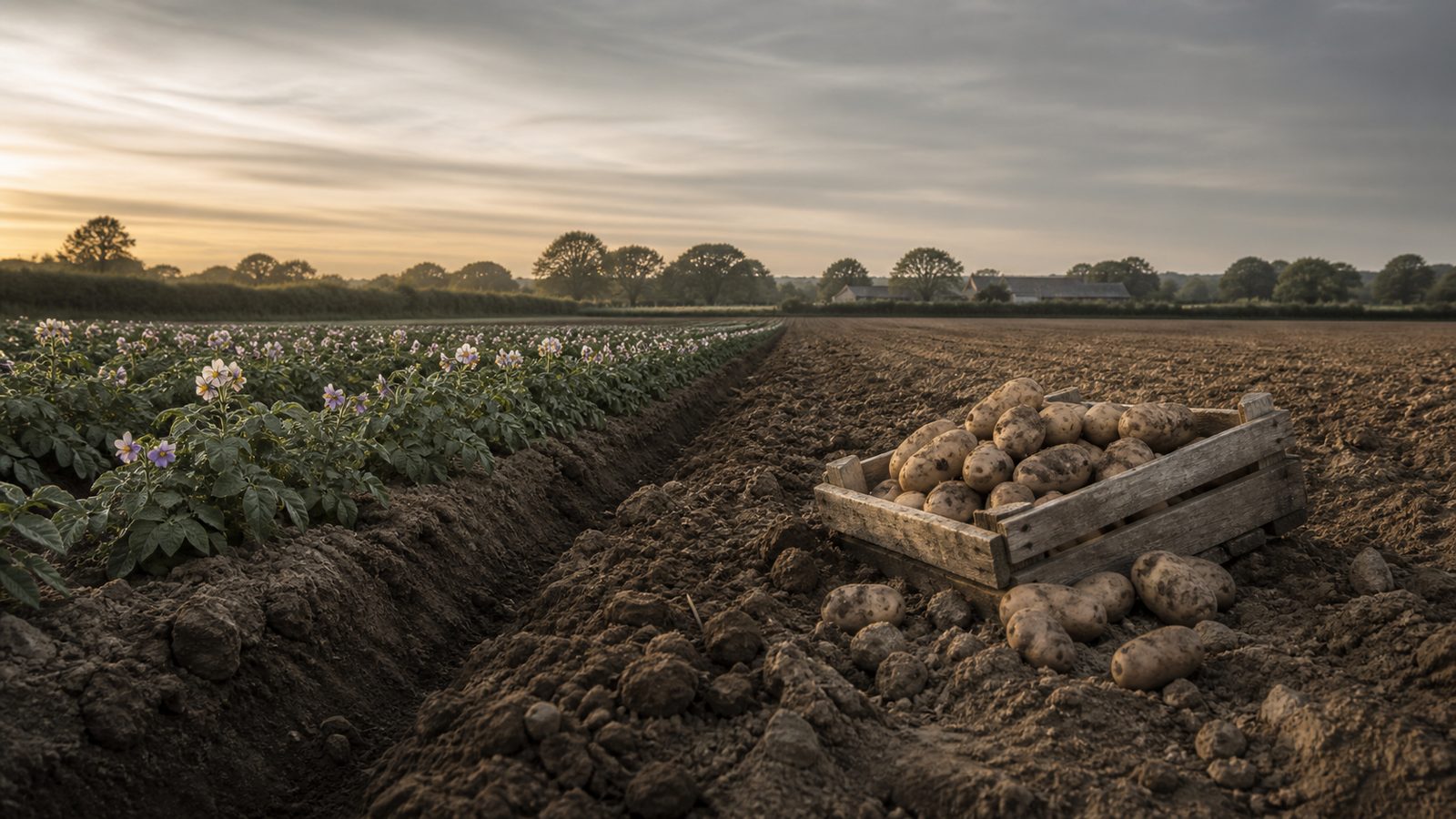
A UK potato field at dawn with rows of flowering potato plants on the left, a deep furrow of sharply detailed turned clods leading to the horizon, a weathered wooden crate of freshly lifted potatoes on bare soil at right, and hedgerow, oaks and stone farm buildings beyond.
Fig. II A potato field at first light, with the crop still in the ground. Generated image
III

The year Essex had one salt-maker.

Little Domesday, compiled in 1086, records salt-houses along the Blackwater; Goldhanger and Heybridge are two of some twenty, and Hugh de Montfort held one and a half salina at Goldhanger. A knight paid rent to Henry III for the Goldhanger works in the 1260s. A guild of saltmakers was thriving across Essex by the 1390s.

Then the state noticed. Salt duty was reinstated in 1693, doubled in 1696, and collected by more than six hundred officials; by 1805 it stood at thirty pounds a ton. It was abolished in 1825, too late.

The Goldhanger works were abandoned around 1810, and by 1825 the Heybridge works had become a mill and maltings. Records for 1833 show a single salt-maker in the whole of Essex. What exists now took its name in 1882, when a firm whose main trade was coal put that name on the salt.
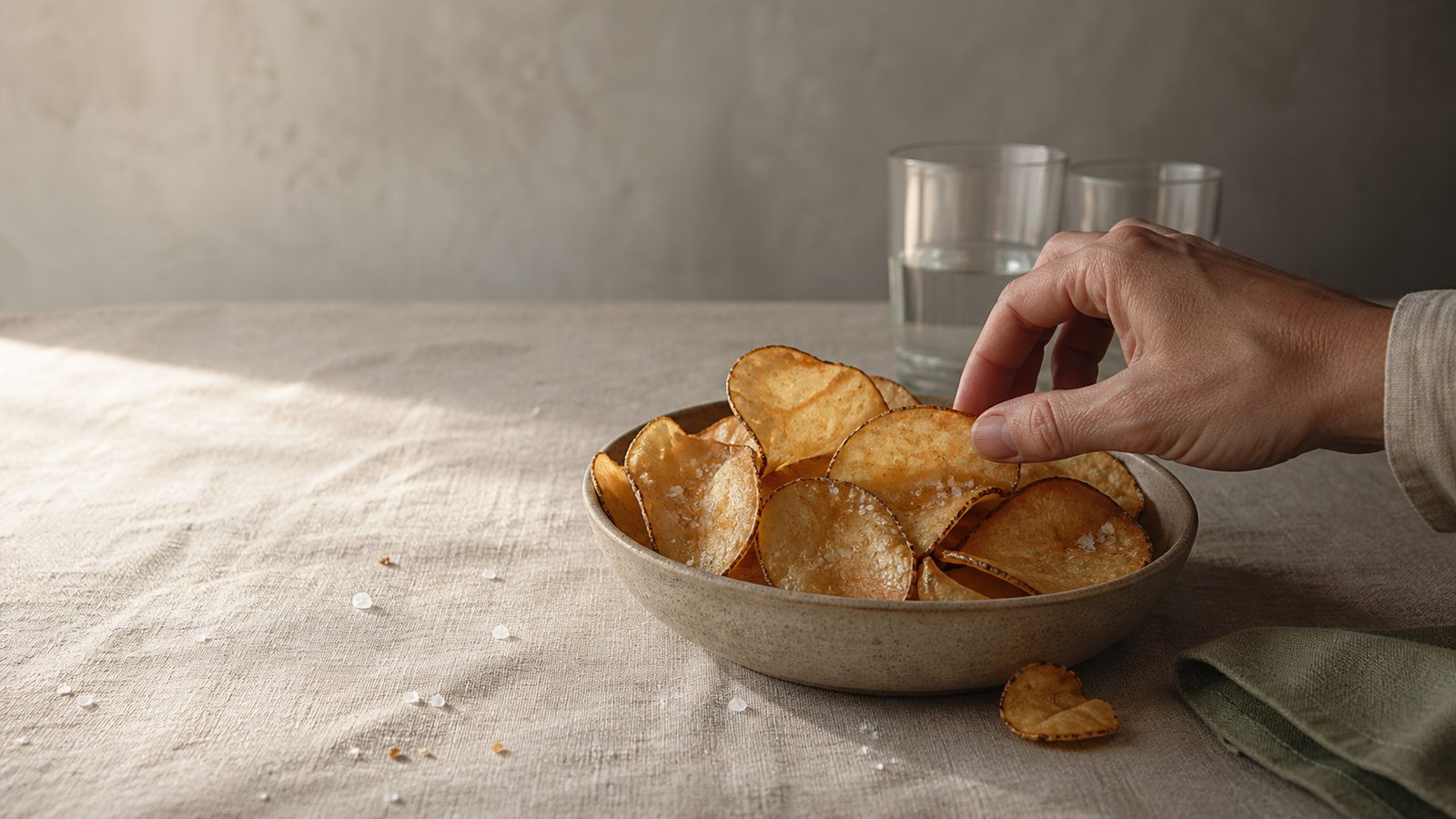
A speckled stone bowl of golden salted crisps on a sunlit linen tablecloth, a hand reaching in from the right to lift one crisp between finger and thumb, with a glass of water and two empty glasses behind and a sage-green cloth at the right edge.
Fig. III The end of the process, which takes about four seconds. Generated image
IV

The pyramid and the apple.

The crystal is a hopper. Growth runs faster along the edges of a cube than across its faces, so the faces fall behind and the crystal builds outward as a hollow stepped pyramid. Halite does this.

The result is a flake: thin, light, all surface, quick to dissolve and read as saltier than it has any right to be. There is no cider vinegar tradition at Maldon and it would be easy to invent one. England's sour was malt, first known as alegar, and much of what gets shaken over chips in Britain is legally not vinegar at all: non-brewed condiment is water, acetic acid, flavouring and caramel colour. Cider vinegar was in print by 1810, in a cookbook that set it beside gooseberry and raisin.

The nearest long-documented orchard is at Aspall in Suffolk, about forty miles to the north-east, planted in 1728 by the Chevalliers with apple trees from their native Jersey. That is another county and a cyder house rather than a chip shop. The honest version is that the vinegar here is a modern choice.
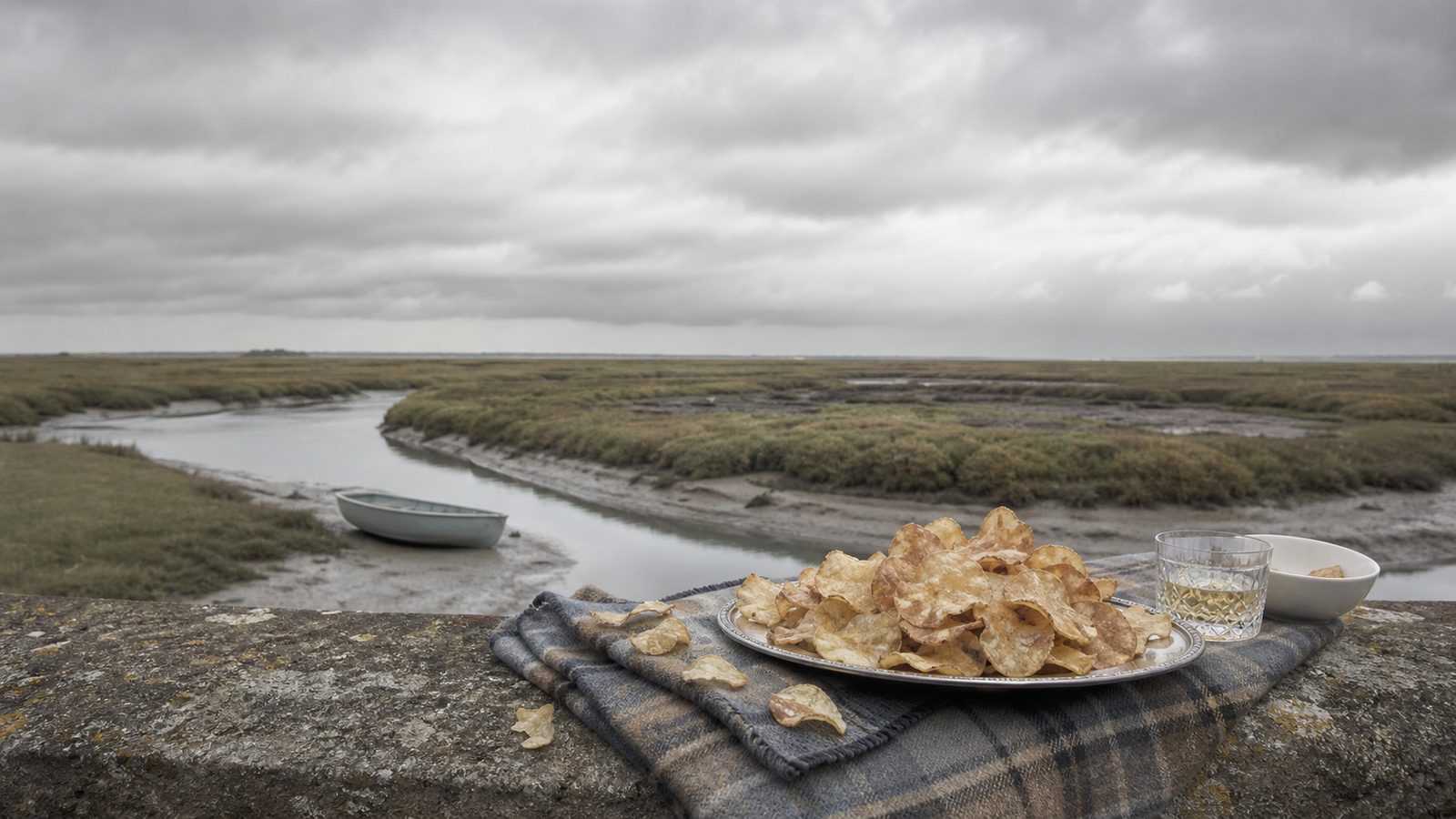
A silver salver heaped with thin blistered crisps on a grey tartan rug, resting on a lichened stone parapet above an Essex saltmarsh, with a small clinker boat grounded on the mud beside a winding tidal creek and a bank of flat grey cloud filling the upper half of the frame.
Fig. IV The Blackwater at low water, and the mud the salt came out of. Generated image
V

The dates

  1. c. 400–100 BC Middle Iron Age settlers move onto the Essex marsh for one purpose: to make salt. Scientific and ceramic dating puts these among the earliest known red hills in the county.
  2. c. AD 250 The Stanford Wharf salt-works is reorganised around four salterns. Lead traces in two of them give the first hard evidence for lead evaporating pans in Essex, and fish sauce is made alongside the salt.
  3. 1086 Little Domesday records salt-houses along the Blackwater estuary. Hugh de Montfort holds one and a half salina at Goldhanger.
  4. 1693 Salt duty is reinstated at a shilling a bushel on native salt. It is doubled in 1696, reaches thirty pounds a ton by 1805, and is not abolished until 1825.
  5. 1833 Records for the year show one salt-maker in the entire county of Essex.
  6. 1882 The Maldon Crystal Salt Company is founded under that name, having previously been part of a local coal firm.

Tasting notes

On the palate

  1. I

    A flake that collapses rather than dissolves

  2. II

    Salt arriving early and leaving fast

  3. III

    Orchard acidity rather than malt

  4. IV

    A flat mineral finish

  5. Serve

    Serve at room temperature, in a small bowl. The flake reads saltier than it is, which means the first handful is correct and the second is an error of judgement.

VI

Matters of record

  1. The Iron Age method has been tested. In a 2015 experiment, seawater steeped with saltmarsh plant ash reached 105 parts per thousand against 60 for plain seawater alongside it, and on evaporation yielded 64 grams of salt against 36. The plants nearly doubled the yield before any fuel was spent boiling anything.

  2. The red hills stop in the late Roman period, and their absence is the interesting part. The same ash-and-brine method carried on, but the marsh sediment that gave the mounds their colour was no longer being lifted with the plants. Someone had worked out how to harvest the marsh without stripping it.

  3. Salt and vinegar is not an ancient British pairing but a corporate counterattack. Tayto made the world's first seasoned crisp, cheese and onion, in 1954. Smith's answered with salt and vinegar, tested through their north-east subsidiary Tudor and launched nationally in 1967.